Sunday, May 31, 2020

Racism Inflection Point - non-gaming post


I grew up in the 60-80's in progressive Berkeley, home of the UC Berkeley campus protests again the Vietnam War. I went to Berkeley High School and UC Berkeley for my Bachelor's Degree. I've never experienced any racism except for some token bullying at school by White kids, mainly some kids either pulling up the corner of their eyes or pretending to speak Chinese by saying "Ching-ching, Chong-chong," but it was very rare, maybe 3 times in my whole life.

The only time I experienced overt racism is when I went to Hudson, MA on a college internship with Digital Equipment Corporation (DEC). My co-workers at DEC, all white, were as accepting as the people I knew in Berkeley, most were from MIT. I took a bus tour of the east coast (NYC, DC, Niagara Falls, Rhode Island) that left from the DEC campus. One lady who was a secretary at DEC, whom I didn't know, made small talk and asked when I was going to marry a nice "Chinese" girl. Interesting that she had to qualify the type of girl I had to marry. I politely answered her question and ignored her racial comment as old white lady syndrome because she meant well. I went to a barber shop and there was a long line of seated customers waiting and the barber told me to go to the saloon next door. Thinking nothing of it, I went next door. A month later, I went to the same barber shop. This time, there was nobody waiting. He still told me to go get my hair cut next door. That's when it hit me: The barber didn't want to cut my hair.

You hear about people who die in their homes and nobody finding the body for months or years. I figure if I died in a racist area, nobody would care. Or if I needed help, it might not be forthcoming.

Since then, I've vowed never to live in a city without a major University and an educated population.

Fast forward to 2020.
Minneapolis 2020 riots

Covid-19 is a pandemic. And there are protests and race riots going on throughout the US.

Rodney King being beat up by cops
I saw the beating of Rodney King on TV during the LA Riots of 1992. I watched Do The Right Thing and didn't quite understood why Mookie (Spike Lee) threw a garbage can through a window. I saw the anger, but I didn't understand completely why. I saw people blocking the freeways in my area during Black Live Matter and didn't quite understand that. I understood peaceful protests like MLK Jr and Gandhi. In Berkeley High, we were taught about the peace movement, but not about the Black Panthers, though Malcolm X was brought up briefly.

Similarly, I didn't understand the current rash of riots until I watched this video (please watch it, it changed my world view): Trevor Noah: The Daily Show#JusticeForGeorgeFloyd.

The last 3 years of President Trump's legacy has been a disaster. He has proven that he's a racist.

I wrote this post on FB:
There were early stories that Trump is a racist. After 3 years, I think they were right. There are stories his dad discriminated against black renters. He called white supremacists wearing khaki and carrying tiki-torches "very fine people." Now, he quotes an infamous line from Miami Police Chief Walter Headley Jr. originally used it during the height of civil rights protests in the 1960s. It's not like he pulled this quote out of his ass. Trump who we know is a very stable genius (self-proclaimed), picked this quote deliberately. I don't think anybody else owns his Twitter account due to bad grammar and misspellings. We know it comes straight from Twitler's head into his cellphone. His hate for Obama. Where could that have come from? They've never met each other. Could it just be that Twitler couldn't stand a Black President? That is why he's been undoing everything that Obama has done? Twitler is a racist, plain and simple.
In response to my post, one of my friends wrote this:
It’s been really obvious that the man is not just a racist, but a hard core old-school racist, since at least the 90s. And if you didn’t realize it by 2010 you just weren’t paying attention. People seem to give him a pass because he just seems too unserious and too dumb and way too many people seem to believe his kind of vicious racism isn’t really that much of a thing anymore. It’s hard to believe he’s motivated by racism when it hardly seems like he has any kind of fixed principles at all and he’s just a grifter and charlatan. But that’s not how it works.
Another of my friends noted this:
People treat him like a child, you wouldn't punish a child because they don't know what they are doing or saying. There's really no malice behind a child's actions. But we elected him president.
Friday, he tweeted that he'd release "vicious dogs" on protesters outside of the White House. This is another racist rant.

Just like the barber who wouldn't cut my hair because I wasn't White, Trump is reversing everything Obama did for the same reason. Not only that, Lindsey Graham and Mitch McConnell are either going along with it or enabling it. Either way, just as bad. It's not just Trump doing this, but the whole GOP government.

So, what do you do when the social contract is broken? (what social contract? See Trevor Noah's video I linked earlier)

All bets are off the table: guns, knives, rioting, protests are all viable responses.

This has all happened before. Riots happened in America 1963-71. Only after passage of the Civil Rights Acts (1964-68) did the riots start to quell. e.g. Civil Rights Acts offered hope of equality and kept the peace for 50 years. LBJ pushed through the Civil Rights Act to stop civil unrest.

But MAGA (Make America Great Again), Trump's signature slogan, hearkens back to White America where "people knew their place."

Would Trump make a peace offering like LBJ? Right now, Trump is offering to use the military to quell the unrest. And police are now attacking reporters and innocent civilians. True to form, Trump is urging crack downs.

Would the protests continue? Right now, unemployment is at 19% due to Covid-19 and people are stuck at home without work for an undetermined amount of time. They have nothing better to do and they are dying from the virus and police brutality.

Civil Rights have been on the rise since 1964. Then with Trump's Presidency, a swift fall. I'm hoping this is an inflection point, a bottom. Depending on how much the riots go on, on how scared the WH and GOP gets, something positive might come of this.


p.s. On 7/22/2020, Vice President Biden called Trump a racist.

p.s. On 9/10/2020, Michael Cohn, Trump's lawyer and fixer says Trump is a racist.

p.s. On 9/23/2020, George Takei.


p.s. On 9/29/2020, during the 1st Presidential Debate for the 2020 election when asked to denounce white supremacists, Trump instead tells a white supremacist group: "Proud Boys stand back -- and stand by."

p.s. Reaction to Trump's Proud Boy comment, it's right out of Hitler's fascist playbook.

p.s. On 1/20/2025, Trump ends DEI programs.

p.s. On 5/12/2025, expedited refugee status of White South Africans to US while halting other refugees from war zones.

p.s. On 10/11/2025, reclaimed Columbus Day.

p.s. On 10/15/2025, proposes changing US refugee system to "giving preference to English speakers, white South Africans and Europeans who oppose migration."

p.s. For 2026, Trump revoked the free US National Park days for MLK Jr Day and Juneteenth. He replaced them with his own birthday.

p.s. On 2/6/2026, Trump posts racist video about the Obamas. WH defends it, but finally takes it down after 12 hrs.

p.s. On 2/16/2026, Trump executive order removes information plaques about George Washington and his slaves. Judge calls this the erasure and rewriting of history, and the plaques must be restored.

p.s. On 3/27/2026, Hegseth blocks promotions of black and women soldiers from promotion to one star generals. https://www.npr.org/2026/03/27/nx-s1-5763860/hegseth-blocked-2-black-and-2-female-soldiers-from-promotions


ps. On 7/7/2026, Judge calls Trump and Vance racist in ruling: https://youtu.be/FDXc5i1IB8s?si=sixJD7OSu05HGp3p

Friday, May 08, 2020

Swords of the Serpentine - Review

I play tested this in January 2019. It's was available for pre-order May 2020. It finally shipped July 2022.

When I signed up for the play test, I was a bit leery of it. I mean how many fantasy RPGs are out there and what would make this different? On the plus side, this was co-authored by Kevin Kulp, who wrote Timewatch, one of my favorite games.

Below are examples from the play test.


Character Creation

There's a lot of customization where you can write several phrases ("What is Best in Life?" from Conan the Barbarian) which helps describe your character and give you an edge when needed.

The Adjectives are self selected for flavor and to help you decide how your character would act in a situation when faced with indecision.


You also pick your alliances and enemies right off the bat, so everyone already has built-in drama.

And Character-defining gear adds 1 pt of Grit, but it's also cool that there's an incentive to create character and backstory based on your gear. Below is gear for a proto-Conan.

So, character creation is colorful and full of flavor.


Investigative <==> General Abilities

One of my complaints about Gumshoe is that combat is a bit lack luster. Night's Black Agents has improved this with Cherries, abilities at 8+ give you special abilities.

Swords of the Serpentine solved this by allowing Investigative abilities to be used in combat. For instance, you can use your Vigilance (Notice skill) to note an uneven spot on the floor (Player defined), so during combat, you can force your opponent to step on that crack and give you a bonus.

This adds more storytelling to a combat scene.

Also vice versa, a high general ability would give you Investigative skills. For example, a high Warfare (Combat skill) means that you have Investigative skills pertaining to weapons and armor.


Sway vs Warfare

Warfare is your standard sword combat. Sway is affecting the morale of an opponent or opponents. With enough sway, you can make your enemies flee (or retreat from) combat. You can insult your enemies until they run away crying. Very cool.


Sorcery

Yes, there's magic and you can use magic to affect your enemy's Health or Morale. Minor magic is exactly the same as doing the same action physically such as swinging a sword, firing an arrow, picking a lock, but to an observer, it is done magically and is more done for flavor. e.g. people climb up the stairs, but you just float. You point your finger at someone at a distance and you can hurt them as if you fired an arrow at them. It's all for flavor.

But there are major magics where you spend Sorcery. You increase your effects and cause as a side effect a blight (your choice: randomly, evenly everywhere, focused on an area, or on yourself). Powerful and illegal in the city.


The World - Eversink

But what is best in life? A kick-ass world that's different and new.

The main selling point of Swords of the Serpentine is Eversink. The city is built on a swamp. Think Venice filled with canals where various buildings continue to sink into the earth and new floors are built upon the old. The rates of sinking vary throughout the city, some take decades to sink one inch and others drop ten feet in one day. New construction changes the city everyday. Think Winchester Mystery House where an alleyway leads to swimming pool whereas yesterday it was someone's roof. People aren't buried, but exposed to carrion birds or sunk into the marshes. Their souls are remembered by funereal statues, but if destroyed their spirits return to the land of the living. so throughout the city are multitudes of funereal statues; grand ones for the rich and powerful, small clay ones for the poor.

The city has 12 factions fighting each other for control of the city. So lots of intrigue and missions for the PCs.

The city is old, so there are rules and regulations buried deep in time. My favorite skill is Laws and Traditions where a PC can declare a law on the spot and it would be true for the entirety of the campaign "except on Tuesdays." 😊

The monetary system is Byzantine and deliberately confusing in mockery of old D&D and old British money.


Summary

I'm really excited this is seeing print. I've already paid for my pre-order and I'm excited to see the final product. Do we need another fantasy RPG? Yes, if it's Swords of the Serpentine. 😊

Tuesday, March 31, 2020

Call of Cthulhu 7th Ed - Theater of the Mind


Recently, someone posted about the need for maps and miniatures for CoC. The reaction was swift and divisive. A majority of the reaction was that CoC wasn't a combat game like D&D and that you should use your imagination and Theater of the Mind. For those not familiar with Theater of the Mind, the phrase came from the days of radio plays where people gathered around a radio and listened to dramas, just like people do today, to watch television shows (I know people don't do this anymore due to streaming and personal devices). Some people did admit to using battlemats and minis or doing a quick sketch and using dice to mark locations.

Battlemat and Minis for D&D
At first, I thought the question was from a GM used to a different style of game (most people thought it was a post by a D&D GM where battlemats and minis are prevalent), so my reaction was the following:

Generally, I run the game with Theater of the Mind. Most people know what a house looks like and such, and most of the time the PCs stay together, so there's not much argument about what's going on. A lot of the newer RPGs have Zones: close, near, medium, and far. They replace the finer granularity of battlemats and you can only move from one zone to another during a PC's action. Most combats in CoC are in close/near range, so the options are either to fight, shoot, or run away.

The only time I've had to use a map was running Horror on the Orient Express (HotOE), on a train with 15+ NPCs. I had a map of the train dining car and placed all the NPCs in various booths and tables and had the PCs mingle and chat with people. It's possible with Theater of the Mind, but a lot harder.

Sometimes when Players tell me they are confused, then I will pull out a piece of scratch paper and do a quick sketch. This sometimes happens in a larger space such as a cave complex with a large number of cultists or important objects such as statues, relics, prisoners, and someone being sacrificed.

I do have battlemats and minis, but I've rarely taken them out for CoC. I have played on roll20.net and mainly used the platform for sharing handouts and die rolling, and rarely for maps and the fog of war where you can slowly reveal parts of the map, but once in a while I will use it. I've used it for The Lightless Beacon as the PCs are exploring an unfamiliar lighthouse in darkness, so it adds to the paranoia.

Another person asked how do you know what's in the room?

If they are in a bedroom, I assume the standard bedroom stuff is present. If the creature comes out of a closet and attacks, I either ask for a Luck roll (lowest result gets attacked) or I've seen other GMs just pick the PC with the lowest Luck score. At that point, the PCs generally look for an improvised weapon. If a PC asks if there's a heavy table lamp in the room, then just ask them to make a Luck roll or just say, "Yes." If for something less likely like a silver candlestick (with the PC thinking that silver would have an adverse affect), you can require a higher level of success. For something extremely unlikely like a loaded rifle on the wall, just say, "No."

Then the poster said he never played D&D and was a Player.

I'm a visual person, so I visualize most stuff like a movie, so I have a strong sense of where things are. But I know that there are tactile people, smell people, audio people, etc. So, it can be a leap for someone new to Theater of the Mind as to how it works. It takes mental training to take an empty white room and populate it.

I bring in what I know about the 1920's, the surrounding context (a diner, a club, a house, a speakeasy), memories of various period movies, and internal logic and consistency -- and visually construct the location.

If you are in a living room or den, I will assume there are sofas, chairs, end tables, a fireplace, and if so, fireplace pokers and shovels, etc. A billiard room will have a pool table, pool sticks, maybe stuffed animal heads on the wall, a rifle or crossed swords and a shield as decoration. When you want as a Player to use one of those said props, you can ask the GM if that object exists in the setting. If it does, assume you can exploit it.

If you are in a room and you want to search it for clues, you tell the GM you are tossing the room for clues and whether you can roll a Spot Hidden. Or if you just want to glance around the room and see something out of place, you can ask the GM and he might ask you to roll a Spot Hidden.

For combat, there is no facing. Just assume there's room for 2 or 3 people to dog pile an opponent unless they're unusually large, but in that case running away is the better solution. In CoC 7th, combat is now a series of blows and struggle, not a single blow, so it's less tactical. You can just say, I'll move to point blank on the bad guy and shoot him. The GM will either let you do it or say, "Oh, there's 2 body guards in the way, you can't. You see the body guards move to intercept you, what do you want to do instead?" Sometimes in a fight, someone is already engaged and you can say, "I'll move up behind the bad guy and smack him with a vase." Generally, the GM with just say, "Because the bad guy is already engaged and outnumbered, roll Fight (Grapple) with a bonus die" which matches your narration. Or in some cases, you can say, "I duck behind a support pillar or sofa for cover." Just assume that type of feature is in the room. If you really can't, the GM will tell you, "Sorry, there's nothing like that in the room or it's too far away. Do you still want to run for cover, it'll take two rounds? Or do you want to just fall prone to the ground? Or do something else?" The key is dialog between the GM and Player, so there is a meeting of the minds as to what's in the room.

So, those are my thoughts on Theater of the Mind for CoC.

Saturday, March 21, 2020

Call of Cthulhu 7th Ed - Sneaking Around in Groups

Stealth as an Individual
Stealth as a Group
A common problem in Call of Cthulhu (CoC) is that sometimes a group of PCs want to sneak into a location and one PC (yeah, that one guy) has the default Stealth of 20%. Or with a large group, by the law of averages, someone would fail even if everyone had a Stealth of 70%. So, how do you handle this fairly?

When someone's Stealth check fails!
I offer a group Stealth check. The PC with the lowest Stealth rolls for the whole group. If the roll fails, the whole group isn't Stealthy. Otherwise, success. But what if several people have a low Stealth score? I give them the option of not sneaking in. They can sit out and do something else while their compatriots sneak in.

World War Cthulhu: Cold War offered another solution. They have a Tradecraft skill. If someone with Tradecraft aided others in Stealth via scouting ahead and using hand signals, they can instead roll a combined skill roll. They roll once and if the die roll is below both their Stealth and Tradecraft, the whole group would succeed.

Trail of Cthulhu (ToC) offered a Piggybacking solution. The PC with the most Stealth points to spend rolls (the Lead), but each PC piggybacking on the Stealth must spend a Stealth point and for each PC lacking in a Stealth point, the difficulty is increased by 2. ToC uses 1d6 for skill resolution, so a 2 pt penalty is pretty hefty. Typically a 4-6 is a success. Having one noisy PC increases the chance of failure by 33%. This can be offset by having the Lead spend Stealth points.

So, another solution is to have the PC with the highest Stealth roll, but add penalties based on the skill levels of the rest of the group. For example: -20% for each PC who only have the default. -10% for each PC with Stealth below 50% but above the default of 20%. -5% for each PC with Stealth above 50%. On failure, you assume someone inadvertently stepped on a twig, knocked over a vase, stepped on a creaky floorboard, or got spotted.

Individual Stealth checks
Another solution is having everyone roll Stealth and those that fail can be noticed, but those that fail are silent and well hidden. This may happen if the PCs scatter and look for various hiding places, like in a closet, under the bed, in a steamer trunk, etc. In this case, I generally ask for individual Luck rolls for those that failed and the one with the worse roll gets spotted and attacked. Sometimes for brevity's sake, the GM could just pick the one with the lowest Luck score instead.

Delta Green uses an opposed Stealth roll. So, there's a chance the bad guys won't notice you even if you have a low Stealth score.

In that spirit, some GMs roll a Spot Hidden for the bad guys, but that should have already been taken into account by the success level required. If the bad guy's Spot Hidden is < 50%, a regular success is required, <90% Hard, >=90% Extreme. And remember, when dice are rolled, it is always for something that matters and at a moment high drama. If the PCs fail a Stealth roll, something should happen.

Well, that's my thoughts on group Stealth.

Thursday, January 30, 2020

Call of Cthulhu 7th Ed - Who rolls dice?


Someone asked whether the Player or the GM should roll SAN Loss. This brings up the general question, "Who should roll dice?"

My immediate answer is that I let the Players roll dice. As a Player, I love to roll dice. So, I assume it is the same for the Players in my games.

I feel it is a philosophical difference as to GM style.

Let's examine why the GM should roll vs Players and vice versa.

If the GM rolls, then the SAN Loss can be kept hidden. Meta knowledge such as how scary the horror is can be kept a secret. e.g. PCs run into a Shoggoth. SAN Loss 1d6/1d20. Some GMs will keep SAN tallies secret and just describe the effects. Some GMs do this with HP damage too.

If the Players roll, then the amount lost is immediately known, but when you tell the Player to roll it themselves, tensions rise, as the immediacy of the roll affects their PC directly. Who talks to their dice more than a craps shooter? "C'mon, seven! Baby needs a new pair of shoes!" The loss range is known too, so there's a Metagame aspect to this, but I think if you run into something minor and roll few dice (1d3) and run into something major and roll bigger dice (1d20), it's not a spoiler.

I prefer full disclosure and have the Players roll. I also do all my die rolls in the open. Also, it saves time. When each Player takes care of their own PC, everything can be done in parallel. Doing each PC one at a time, takes more time and could deflate the atmosphere, as each Player waits for their turn. Also when they see that I roll a 65 and the monster still hits, there's usually a moan at the table as they understand the monster has a high combat skill. In some very rare cases, I do make some hidden rolls.

I've been in games where the GM is a full-on storyteller, describing everything in deep detail. My issue with this is the Player becomes a passive listener. Nothing wrong with a story told by a great storyteller, but for me, that is what a movie or book is for.

For me, a RPG is a cooperative storytelling game. I want to give you just enough details to build the story in your own mind, so you can add your own details and then interact with it. I don't want to tell you everything you see and feel. I want you to generate that. I want to give broad strokes and you fill in the details. For me, there's a barrier that shouldn't be broken between the GM and Player. I give you details and hints, but the Player is the final arbitrator as to how the PC feels and thinks about something. I will NOT tell you how your PC feels or thinks, except when the system absolutely requires it (Insanity or the rare case of Possession by an other entity). Even for Insanity, I would roll on the insanity chart and ask the Player as to what makes sense for their PC. I really want to give the Players as much agency as possible.

I see several types of skill checks based on timing, when the skill roll is made and when the die roll effect surfaces:

  • Immediate Skill Check
  • Delayed Skill Check
  • Hidden Skill Check

Immediate Skill Check:
When a PC is acting and there's doubt as to whether an action is successful, there is a skill die roll. The result is immediately applied. For example: Locksmith (lockpicking), Fighting, Firearms, Fast Talk, Library Use, Jump, Climb. In those type of skill use, the Player rolls dice and the result is applied immediately.

Delayed Skill Check:
When a PC is acting, but there's doubt as to whether the action passes muster after a significant amount of time passes. For example: Disguise, Forgery. In those cases, I prefer to delay the skill check and have the Player roll the skill roll when it matters. e.g. a PC disguises himself to enter a speakeasy. No die roll is required in getting past the door guard, only the password is needed. But inside the speakeasy, an NPC who has seen the PC before (and probably told the PC never to show his face in there again) has a chance of noticing the PC. That is when the PC rolls his Disguise Skill, at the moment of highest drama.

Hidden Skill Check:
When something happens to a PC unknowingly (or there's doubt as to success) and the GM wants to keep it a secret from all the Players. e.g. Possession by an other entity with nefarious intention.

There are various ways to take care of this:

  • GM rolls dice in secret. Generally, the GM will have to ask to see the PCs character sheet to check the relevant skill.
  • Player is asked to roll dice without explanation. Generally, the GM will have to ask to see the PCs character sheet to check the relevant skill.
  • All Players pre-rolls % dice (20 times) and the die rolls are written down and given to GM. Generally, the GM will also ask the Players to write down the PC's Spot Hidden, Listen, and Psychology skill % also. GM looks up die roll vs specific skill and acts accordingly, crossing off the used die roll.
For hidden Possession, I'd generally just have everyone roll dice and tell me their results whether one PC is targeted or all of them. This hides who is being targeted. And instead of telling the PC they're Possessed, I'd wait until some critical moment and then say, "Remember when I asked everyone to roll % dice? Well, you didn't make your save and because of that instead of helping that PC up from the cliff face, you step on their fingers. Oops!"  Remember, the moment of highest drama.

For Psychology skill rolls, I let all observers roll. There is some Metagaming involved as those that succeed "know" whether a NPC has something to hide or not. I may not outright say the NPC is lying, but I may indicate through tells (nervousness, ticks, behavior) that the NPC is not happy with the line of questioning. I do not explain any reason for the behavior, just that the NPC is uncomfortable. Now, sometimes I pick a NPC voice that seems very untrustworthy and let it go at that. Some GMs like to keep Psychology rolls a secret because there's a belief that it fosters more role-playing.

There's also another grouping of skill checks based on how many PCs get to roll:
  • Individual Skill Check
  • Cooperative Skill Check
  • Group Skill Check

Individual Skill Check:
Every PC gets to roll a Listen, Spot Hidden, or Stealth. Those that fail, fail; those that make it, succeed.

Cooperative Skill Check:
One or more PCs may get to roll, depending on the situation; this is where more than one PC is working together to succeed in a skill. See p.88-89 Keeper Rulebook, Physical Human Limits, where you subtract the weakest stat from the target number and the PC with the highest stat rolls. Also see First Aid, p.65 Keeper Rulebook, where 2 people can try to administer First Aid, both get to roll.

Group Skill Check:
The PC with the lowest skill rolls for the whole group. I use this for a Group Luck roll and Group Stealth. You either succeed together or fail together. I offer Group Stealth as an option to Players.

So for me, I let the Players roll most of the dice except for monster attacks and monster damage; I still like rolling dice (my main beef with the Cypher System). I let the Players roll their skill checks, attacks and damage, SAN checks and resulting SAN Loss. I don't worry about Metagaming and trust my Players to keep it at a minimum.

Monday, December 23, 2019

d20 vs BRP (or the evolution of the d20 system)

Someone recently asked on FB why Call of Cthulhu (and Delta Green) which uses BRP was so un-intuitive, requiring low rolls for skill checks and combat. He thought that d20 was much more intuitive with adding your skill level and bonuses to your die roll to meet or beat a specific target number.

Actually, BRP was more consistent and intuitive than d20 for a very long time.

It's all a matter of history.

D&D (1974-1976)
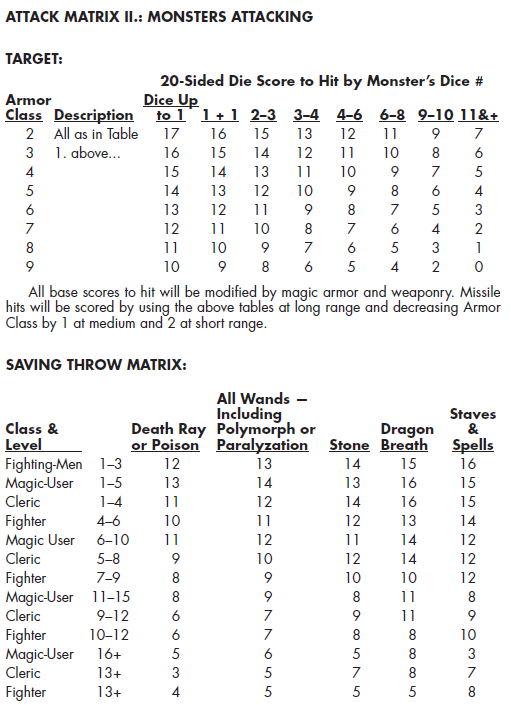
Once, a long long time ago, there was a game called D&D (1974). Armor Classes (AC) went from 9 (no armor) to 2 (plate mail + shield). You had to roll high on a d20 to hit someone in better armor and there was a lookup chart based on your Hit Dice (level) to see if you could hit that armor class. A natural 1 was a miss and a natural 20 was an automatic hit. A 1 HD attacker needed to roll a 17 or better to hit AC 2. There was a lookup chart for saving throws based on level and class vs various dangers such as Poison, Dragon Breath, and Spells. It was a weird thing where you had to roll high to hit lower ACs. The whole system was built to be consistent where you had to roll high to succeed.

D&D (1974) - Attack and Save Matrix
Arduin Grimoire Trilogy (1977-1978)
In 1977, David Hargrave published The Arduin Grimoire, supplements to D&D. It had critical hit and fumble charts, new monsters, magic spells, and items. If you rolled a 1, you rolled % on the fumble table which ranged from a glancing blow to critically hitting yourself. If you rolled a 20, you rolled % on the critical hit chart which ranged from ruining an eye to decapitation.
Arduin Grimoire (1977) Critical Hit and Fumble Charts

AD&D (1977-1979)
AD&D came out in 1977-1979 after Arduin Grimore and added their idea of a critical hit (though in the text of DMG they poo-pooed the idea of critical hit location tables or double damage); if you rolled a 20, it was good for 6 consecutive armor classes, then you needed a 21, 22, etc. to hit higher armor classes. It also introduced the idea of THAC0 (To Hit Armor Class 0). Save throws still required rolling high to succeed. But a thief had skills where you had to roll your skill or below to succeed. So you had to look up your level and skill on a table to see what number you had to roll to succeed. Every time your character leveled up, you needed to update your skill %. AC 2 stayed the same (now requires a 18 to be hit by a 1st level attacker) and AC 10 was now "no armor."
AD&D (1979) DMG - Attack Matrix
AD&D (1977) Players Handbook - Thief Table

Call of Cthulhu (1981)
Chaosium (BRP, 1981), publisher of Call of Cthulhu, decided it was easier to just roll your skill or below. It was more intuitive. You roll low to succeed. No special tables were needed (except for the dreaded Resistance Table, a look up table for POW vs POW). BRP is a skill based system, not a level based system. If your skill was 40%, you just needed to roll 40% or less on your percentile dice. If you roll low enough (1/5 of your skill, 1/5 * 40% = roll 8% or less in this example) you do an impale and cause double damage. A natural 01% was a critical success. A natural 100% was a fumble. BRP was consistent overall. Roll low to succeed for combat, save throws, and skills.

D&D 3.0 (2000)
Then D&D evolved (D&D 3.0, 2000) and Armor Class became a number you just had to roll or beat to hit your opponent. Still, rolling high to succeed. And your bonuses were based on your level, so you don't need a special table anymore. The AC was now the number you had to roll (with bonuses) in order to hit. Critical Hits were added. If you rolled a natural 20, there's a chance of a critical hit if you roll again and score a hit, you do double damage (so much for poo-pooing critical hits). Saving Throws and Skill Checks switched to DC (difficulty class) where you had to roll the number or higher to succeed. So, now D&D was consistent for combat, save throws, and skill checks. Roll high to succeed.

D&D 5.0 (2014)
D&D 5.0 (2014), Critical hits were now just your natural 20 causing double damage. Also some skills (assassinate) cause critical hits and some magic weapons generate critical hits on lower numbers such as a natural 19 and 20. So, D&D went full circle back to a natural 20 being a critical hit.

Pop Quiz: When is AC 2 better than AC 10? When is AC 28 better than AC 10?
Answer: Depends on your version of D&D. ðŸ˜Š

Thursday, December 05, 2019

The Yellow King RPG (YKRPG) - Review of GUMSHOE QuickShock

Slip case turns into GM screen. Actual product.

Inside of slipcase as GM screen. Paris book and Shock and Injury Cards. Actual products.
Slipcase on the right is not the actual product, but a mockup, real slipcase is a bit narrower and has no printing or embossing on the side.
This shows the 4 setting books in YKRPG.

GUMSHOE QuickShock


I play tested (as a Player) The Yellow King RPG (YKRPG) and enjoyed it, but I didn't really understand the streamlined aspects of GUMSHOE QuickShock until I ran it as a GM.

Instead of managing resources for Investigative Abilities, Players are just given 2 Pushes, floating points that can be used with any Investigative Ability. This got rid of a lot of unnecessary resource management that happens with GUMSHOE 1.0. So, instead of having various Investigative Ability points and having Players trying to decide if they want to spend any, that is all gone. They just have 2 floating points to spend. Much easier to keep track of and it ups the importance of the two points. I handed out physical tokens for the points which have to be turned in when spent.

In the game I ran, 3 Pushes were spent. One to make an exceptional sculpture of a tuberculosis patient, just because the PC had "some people I sculpt die suddenly" as That Deuced Peculiar Business. Another spent a Push on convincing a NPC to tell more about a Blackmail that was happening. Another spent a Push after the scenario to author (spoiler, hover over green fairy box to display):
The Phantom of the Opera.

The new single round Fight system also streamlined combat into one round and makes it more narrative. A great improvement to the old lackluster combat from Trail of Cthulhu. What is impressive is that Night's Black Agents added complexity to combat to spice it up, but YKRPG went in the opposite direction and simplified it even more. My mind is blown that you can do that and succeed.

In combat, Players first decide their desired outcome: kill, escape, other (subdue, take an item, etc.). Depending on their desired outcome, the difficulty level is adjusted. Non-lethal is easier than lethal outcomes. Then each PC spends Fighting points and add 1d6. If the total equals or beats the secret target number, it is a success and the margin of success is recorded. If the total is below the target number, it is a setback and the margin of success (failure) is adjusted. In the end, a negative margin of success means the PCs failed (and the GM narrates what happens); otherwise they succeed in their declared outcome. As each PC spends points, they must describe what action they're taking, their 1d6 + Fighting spend determines how successful they are. This is how the narrative part kicks in. After every PC describes their action and each action is either a success or setback, we get the final resolution.

In combat, any failure results in an Injury represented by an Injury card. A -1 margin of success results in a Minor Injury. A -2 (or worse) margin of success is a Major Injury. The Injury cards have flavor text, mechanical penalties, and rules on how to get rid of the card. This also adds a narrative twist to combat.

For other tests, there are either physical Injury cards or mental Shock cards.

In the game I ran, a NPC had a gun and was going to shoot at a PC. The goal: take the gun away. One PC wanted to restrain the NPC; one PC wanted to slap the NPC's gun hand away, so it can't aim at the other PC; the last PC wanted to wrestle the gun out of the NPC's hand. They all succeeded and dog piled the NPC and took the gun away. This turned out to be a lot more cinematic than "Ok, each of you roll combat skills; roll 1d6-2 for damage; he's still up; roll attacks again; he finally goes unconscious; you take his gun." And this new Fight system only took one round of dice rolling.

For tougher creatures, a fight always takes a Toll. Some creatures automatically costs points in Athletics, Fighting, and/or Health (combination determined by Player). This mainly just wears down the PC and may result in an Injury if the PC can't pay the Toll.

In the new QuickShock system, the Injury and Shock cards describe the physical and mental health of the PC. When the PC receives their 3rd Injury or 3rd Shock card, the PC is either dead or insane (this is for Horror mode; in Occult Adventure mode, it's the 4th card instead of the 3rd that knocks you out).

Overall, I really like this new streamlined GUMSHOE QuickShock. It's more narrative and more cinematic. Gone are the dull multiple rounds of rolling a single d6 and wearing down an opponent.

QuickShock Injury and Shock Cards


I ordered the cards and they came in handy. Of note, the cards came in a weird unsorted order. The first thing that I did was to sort all the cards alphabetically. Having the cards is really useful for face-to-face games. If you're just running your game online, then the PDFs work great and you don't need to spend extra money for the cards.

PARIS - Character Generation


Character generation is quick and simple with the selection of an Investigator kit (Investigative Abilities where you can spend Pushes) and a General kit (General Abilities with points such as Athletics and Fighting). The 7 Investigative kits are based on area of study such as Sculptor, Painter, Poet. The 9 General kits are based on background or previous training such as Farm kid, Factory worker, Former med student, Former cadet.

Players then choose Drives and Relationships between PCs. That's to add flavor and to prevent PCs from turtling and avoiding investigations.

The best innovation is That Deuced Peculiar Business, a strange eerie event that has touched the PC. The Player picks or invents one for their PC. It became easy to weave this Peculiar Business into the start of a scenario. I took elements for each PC's Peculiar Business and inserted it into a poster for an upcoming event. That really kicked the PCs into gear.

PARIS - 1895 Setting


The Paris Exhibition (World's Fair) was in 1889 and the controversial Eiffel Tower was built for it. Famous authors, composers, scientists, and artists flocked to Paris. This was a golden age where you can run into Cezanne, Degas, Debussy, Gauguin, Proust, Renoir, Rodin, Mme Curie, Louis Pasteur at your local cafe, bookshop, theater, or bar. The book lists pages and pages of NPCs. Unfortunately there were no photographs or examples of their work in the book, so I went crazy Googling everything that was mentioned.

Maps of Paris:

The setting is amazingly rich and I'm learning a lot about the Franco-Prussian War and the Paris Commune.

YKRPG - Product Quality


The slipcase that turns into a GM screen is amaze-balls. It's held together with hidden magnets and works really well. It's a really beautiful product. See above pictures.

Due to having a new print house, there were issues in having the product delivered in time, but the wait was worth it. A minor issue was that the non-native English speaking printers had a typo on the spine of the Aftermath book ("Aftremath"). But I haven't spotted any typos in the Paris book.

I rushed getting my Shock and Injury cards from DriveThruRPG and that was a mistake. There were a few typos and errors found, but the PDFs have been corrected and if you order these cards now, they've been corrected. But be wary of secondary market cards (eBay) and make sure you're receiving the corrected ones. The incorrect cards can easily be spotted. The Shock cards have the word "Injury" on the detail side of the card instead of the word "Shock."

Conclusion


I really love this new iteration of GUMSHOE and the Paris setting is wonderful and perfect for The King in Yellow. Absinthe, Impressionistic Art, the Can-can, Moving pictures, Cafes, all make an interesting soup of science and art.

p.s. I haven't gotten to the other 3 books yet: The Wars, Aftermath, This is Normal Now.
p.s.s. I've finally gotten to the other 3 books. Review blog post is here

Saturday, November 23, 2019

Call of Cthulhu 7th Ed - Insanity Q&A

There's been a surge of interest in Call of Cthulhu due to Critical Role's The Shadow of the Crystal Palace video. Over one million views of the game play.

Lately, there's been a surge of questions on how the Insanity mechanics works in CoC.

Here's a flowchart by Theodor Paues who posted it in the Call of Cthulhu Role-Playing Game & Players group on Facebook (click on chart to expand):

This basically distills several pages of rules onto one page.


Q: Is it true during a Bout of Madness, the PC is immune to further SAN loss?

A: Yes, but if the PC snaps out of the Bout of Madness while still in the presence of a Mythos creature or other Insanity invoking sights, they are subject to SAN loss at that moment. See p.164 Keeper Rulebook, sidebar: "A Note about Delusions and Sanity Point Loss."


Q: What about Underlying Insanity? How long does it last?

A: It lasts for 1d10 hours. If there is a single point loss during this time period, another Bout of Madness will occur. I wouldn't reroll for another random Bout of Madness, but accentuate what had happened before. See p.157-158 Keeper Rulebook, Insanity Phase 2: Underlying Insanity.


Q: How long is 1d10 rounds for a Bout of Madness, if not in combat?

A: The GM should just gestimate the time. Play out the Bout of Madness and let the PC snap out of it at the appropriate dramatic moment. Assume a combat round is 2-5 seconds or so.


Q: Should I roll a random Mania or Phobia or choose?

A: I like to roll on the chart for inspiration, but if the rolled entry doesn't make any thematic sense, then I'd just pick one that makes more sense. I have also asked the Player as to what type of Mania or Phobia they want. If appropriate, I use their suggestion or sometimes tweak it a little to make it more interesting.


Q: What use is Psychoanalysis?

A: In the short term, enable an insane PC to temporarily ignore a phobia or mania. See p.162 Keeper Rulebook. Also help an insane PC see through a delusion. See p.163 Keeper Rulebook. For long term treatment of a PC that's Insane or suffering from a Mania or Phobia. See p.72 Keeper Rulebook. 

I also allow (house rule) Psychoanalysis to snap a PC out of a Bout of Madness early, if the psychoanalyst (or Alienist in 1920s speak) succeeds in the skill roll. This doesn't recover any SAN points, but it's basically shock therapy seen in movies where the patient is slapped or shaken and told to snap out of it. This is useful during combat when you discover that most of your fellow investigators are either cowering in a corner or frozen with fear and you desperately need help.


Q: Is there a chart for Delusions?

A: No, just make something up that's thematic. Also keep in mind that you can use the Delusions to foreshadow an Insane Insight in the future. See p.169 Keeper Rulebook, "Insane Insight."


Q: Can a PC be hardened to seeing horrible things?

A: Yes. See p.169 Keeper Rulebook, "Getting Used to the Awfulness." You max out on SAN loss, but that is on a creature by creature basis and over time, this hardening softens by 1 pt each development phase. In Pulp Cthulhu, one Pulp Talent is Hardened where you are immune to SAN loss for violence against humans.

So, who keeps track of this hardening? I make the Players keep track. If they don't I'll assume they've fully recovered from the awfulness and can be affected again. Generally, the PCs won't be exposed to the same Mythos creature between random scenarios unless it's a campaign. If it's a campaign, then at some point they'll become immune to seeing a reoccurring Mythos creature, probably by the end of the 1st or 2nd session.


Q: Top of p.155 Keeper Rulebook: "When encountering one ghoul, the Sanity point loss is 0/1d6. It is the same when encountering multiple ghouls; the sanity effect is for the encounter rather than each ghoul."

How long does 'an encounter' last?

Let's say there are some catacombs the investigators are going through. At opening to the catacombs is a ghoul. Half way through there are 2 more ghouls. And at the exit there is a last ghoul.

One investigator can only lose a maximum of 6 points from the 'encounter' with the ghoul, but is the above 1 or 3 'encounters'?

A Depends on the situation. When they first encountered a ghoul for the very first time: OMG, it's something out of this world! (SAN check). When they see a group of 2: OMG, it's more common than you thought! (San check). 3rd ghoul at the end: Ok, another ghoul (no SAN check), unless they're running for their lives and this last ghoul can kill them. Oh, F*ck, a ghoul! (SAN check).

Part of it is the circumstances. For a first encounter, of course, you always have SAN check due to seeing something out of this world. If a next encounter reveals something they haven't seen before whether there's a gaggle of the creatures or whether they're eating human flesh, that would change the circumstances enough to force another SAN check.

It's also about pacing, at some point, making the die rolls will get tiresome and you can do a gut check as to whether the PCs have maxed out their 6 SAN loss already. It's ok to be a bit sloppy here, maybe one PC only lost 5 pts, but it's not worth sweating over that last point if it slows down the pacing of the game for the whole table. Each time you do a SAN check, it does kill the pacing of your game a little, unless it's a massive loss where you know someone will go insane.


Q (GN): In Getting Used to the Awfulness, how do you do the die rolls? For instance, seeing a monster is 1/1d6 SAN loss. When you see it again, is it 1/1d5 SAN loss?

A: No, you continue to use 1/1d6 SAN loss, but if the loss happens to hit the max, reduce the amount lost. For instance, max loss is 6 in your example, so if a PC lost 4 pts, then when PC sees the same monster again, if you roll more than 2 pts, just lower the additional loss to 2 pts for a max total loss of 6 pts. Then any future sightings during the scenario will incur no SAN loss as you've gotten used to the awfulness.


Q: Even though you're reading a Mythos Tome over long periods of time, weeks or months, does it still cause Insanity?

A: Yes. See p.174 Keeper Rulebook, breakout box example. That is part of the Mythos and game. Reading and understanding books written my mad monks will drive you insane when you finally understand that the mad ramblings are really telling you the actual truth about the world around you.

But remember to use p.159 Keeper Rulebook, Table VIII: Bouts of Madness - Summary instead.


Q: When reading a Mythos Tome, which order do you apply Mythos gain and SAN loss?

A: The SAN loss and Mythos gain are applied simultaneously. For example, if the PC had a 68 SAN and Max SAN 70 before reading the book. Book has Mythos gain +5% and SAN Loss 2d6. Max SAN drops to 65 after the +5% Mythos gain.  Assume SAN Loss was 2 pts (lucky fellow), but 68 - 2 = 66 SAN, but that is higher than his new Max SAN, so the PC's SAN is lowered to 65 instead.


Q: p.419 Keeper Rulebook on "Initial Reading," it says, "Roll for Sanity loss," does that mean the PC gets a SAN save to see if they lose any SAN when reading a Mythos Tome?

A: No. That is bad phrasing. The SAN loss for reading any Mythos Tome is automatic, there is no avoiding it. When it says roll for SAN loss, they mean roll the amount of SAN lost, not a SAN save. It should have stated, "Apply Sanity point loss" instead. See p.174 Keeper Rulebook, breakout box example.


Q: Do you lose SAN for skimming and careful reading of a Mythos Tome?

A: Yes, you lose SAN every time you read a Mythos Tome, whether Initial or Full. You may also read a Mythos Tome multiple times. Each time you do a full reading, the reading time doubles. See p.419 Keeper Rulebook.


Q: What does it mean when I see "San Loss: 1/1D8" or "1/1D8 Sanity points?"

A: San Loss: Success/Failure. The number to the left of the slash is the amount of SAN loss if the SAN Roll succeeds. The number to the right of the slash is the amount of SAN loss if the SAN Roll fails. See p.154 Keeper Rulebook, Sanity Points and SAN Rolls.


Q: When do you get a Phobia or Mania? 

A: See p.157 Keeper Rulebook, Table VII, Bouts of Madness. 9: Phobia; 10 Mania. I only give a Phobia or Mania if a 9 or 10 is rolled on the Bouts of Madness. The Phobia / Mania will be based on the current scene. If Phobia, the PC will react in fear, Mania some sort of fascination. I leave it up to the Player to decide and act out in an appropriate manner. See p.159 Keeper Rulebook on Phobic and Manic Responses While Insane.


Q: I'm getting Involuntary Action, Bouts of Madness, and Temporary Insanity mixed up. What's what?

A: If a PC loses 1+ SAN, they automatically have an Involuntary Action. See p.154 Keeper Rulebook, 2nd column: Jump in fright, Cry out in terror, Involuntary movement, Involuntary combat action, Freeze.

If they lose 20% SAN in one day (20% tally starts after a night of rest, e.g. 50 SAN in the morning, so 20% is 10 pts total), then they have Indefinite Insanity. They have an Involuntary Action, followed by a Bout of Madness, and then Underlying Insanity which lasts until the end of the scenario or campaign chapter (p.158 Keeper Rulebook, Insanity Phase 2: Underlying Insanity) or until they get treatment (p.164 Keeper Rulebook, Recovery from Indefinite Insanity).

If they lose 5+ SAN, roll their INT or lower, then they have Temporary Insanity. They have an Involuntary Action, a Bout of Madness, and Underlying Insanity which lasts 1d10 hours. During the 1d10 hours of Underlying Insanity, any loss of SAN would cause another Bout of Madness.

If the PC is with other investigators, the Bout of Madness lasts 1d10 rounds and Table VII: Bouts of Madness - Real Time is used. See p.157 Keeper Rulebook. Phobias and Manias are permanent. During a Bout of Madness, another PC may try to temporarily snap the affected PC out of it by using Psychoanalysis.

If the PC is alone, the Bout of Madness lasts 1d10 hours and Table VIII: Bouts of Madness - Summary is used. See p.159 Keeper Rulebook. I meld the Underlying Insanity with the Bout of Madness, so the combined duration is just 1d10 hours since there is not another PC to snap the PC out of the Bout of Madness.


Q: How do you read / use roll20.net's SAN in the character sheet?

A: This is for the following version which I prefer (over the "CoC 7th Edition by Roll20"):

"Current SAN" and "Starting SAN for today" are editable. "Start SAN -20%" and "Max SAN" are auto calculated. Enter your current SAN in the "Current SAN" box, default is starting POW, update this as you lose SAN. At the start of a scenario enter your current SAN in the "Starting SAN for today" box. If your SAN drops to "Start SAN -20%" (or 64 in this example), you automatically experience Temp Insanity. "Max SAN" is 99 - Cthulhu Mythos.


Q: As a GM, should I describe the horribleness and then ask for a SAN check or vice versa?

A: TL;DR: Describe first, then ask for the SAN check afterwards.
Here's my long answer in a separate blog post.


Q (CB): Looking at examples (breakout boxes) in the Keeper Rulebook p.158, Harvey's Bout of Madness is Violence. Why does he on p.159 have paranoia? I'm confused.

A: Example on p.159 is an example of Insanity Phase 2: Underlying Insanity (p.158). The Player is just roleplaying the underlying insanity caused by the fear that there are hidden devices triggered by his Bout of Madness. This "paranoia" will last 1d10 hours.


Q (GVS): I'm a new Keeper and so far I've been pretty unhappy with the way I run SAN. It looks like a fairly hard mechanic to use and make exciting.

It feels like you're playing D&D and your PC is loosing HP just going through doors because they're booby-trapped, without opportunity to fight back. Actually, it feels even like I'm mean to my player: "You get in the room, there's a butchered and stinky corpse there, I hate you, loose SAN, you should not have opened that door you dumb moron."

I just feel terrible that "behind this door is a trap SAN roll, and my players can't possibly know about it, and even if they could know, there's nothing they could do about it. They must open the door to move forward, and that'll screw them".

A (MH): CoC is a horror game. There is the tension between: "I don't want to, but I have to." I don't want to see or find out, but I have to, to solve the mystery, to save my friends, my family, the world (sometimes). The price is SAN loss. You have to push up this tension between the two in the game. In your example, yeah, there's some horribly butchered corpse that's dripping blood. Now ask the Players to roll Spot Hidden. OMG, now some of the PCs see a clue, a bloody slip of paper poking between the teeth of one of the corpses. You have to now climb over a pile of bodies and pry it out of the mouth. Oh, NO, no, no, nooooo. I don't want to, but someone has to!

Comment (TS): You have to pay to play.

(MH): The cost of investigating is SAN and / or HP loss. As you investigate more and get deeper into the mystery, it should cost more and more. What's the breaking point between "I don't want to, but I have to?" When does the PC decide "I don't want to?" As a GM, you have to read the table. At some point, a few PCs would "turtle" and stay behind. Others will enter alone. You want to be on the balance point of the razor's edge. If they all "turtle" then you're too heavy on the "I don't want to," then you'll need to either let them gather their courage, set a ticking clock, or chase them out of their hiding place. Subtly or forcefully push them to "I have to."


Q (GVS): It's really the moment I ask for a SAN roll that feels arbitrary to me. I'm kinda okay with the Bout of Madness reactions and how to make them interesting, but the "behind the door was something horrible, bad luck to you, roll SAN." I feel like the player should be able to do something in between the scare and the SAN roll, either to mitigate the damage, avoid the roll, or prepare to the loss. Giving more agency to the player with regards to when a SAN roll should happen and / or what they do.

A (MH): I always give hints such as a bad smell or fluids leaking under the door (if it's obvious, otherwise, it's a Spot Hidden). Then it's up to the individual PC as to whether they enter the room or open the door. Others may decide to just hang back and not look.

When I play and encounter a dead body (and take some SAN loss), I generally throw a sheet or something over the dead body to mitigate SAN loss for the other PCs.

Most SAN loss has a 0/1d4 SAN loss for non-supernatural horror, so if they make their SAN check, they lose nothing. So, when they take 0 SAN loss, they were able to steel themselves, and avoid taking any SAN loss.


Q (EW): I have players that "game" the system -- for example -- not looking at horrors, not reading mythos tomes, plugging their ears, etc. in efforts to preserve their Sanity.

It becomes comical and totally ruins the horror mood!

What are some good Keeper tips to circumvent this?

A (MH): Not looking doesn't work unless it's just a normal blood splattered crime scene. By not looking, you can't get the clues. If it's a creature, then there are other senses (sounds, odors, noise, dripping mucus) that come into play and also an otherness that grips their mind, so not looking will still incur a SAN loss, but now the creature can just come up to them and have a free attack that can't miss.

Not reading mythos tomes is fine. But sometimes a solution to killing the creature or the creature's nature is explained in the mythos tome. Or there's a spell in the tome that affects the creature. Good luck with that.

It won't become comical, it'll become a horrible TPK.


Q (RH): When measuring 1/5th for sanity loss, do you round up or down? For example: How much sanity can someone with 47 SAN lose before indefinite insanity?

A (MH): I round up to 10 SAN loss. The pathological case of 4 SAN would be 1 if you round up, 0 if you round down. Also this is in the favor of the PC. I give more breaks to the PC, so when things go bad, I can say I gave them all the breaks.

If you calculate it precisely, then 20% of 47 is 9.4. You can only lose SAN in whole numbers, so the answer would be 10 SAN loss. 9 loss won't hit the threshold. 10 crosses it.

Some people say use the Quick Reference Chart for Half and Fifth Values on p. 420 Keeper Rulebook. You will see that the 1/5 value for 4 SAN or less is 0. This is the pathological case I mentioned above.

Some people say CoC always rounds down, so the answer is 9 SAN loss. But if you revise the question to: At what current SAN do you get an Indefinite Insanity? Then rounding down means 37 SAN for that day's Indefinite Insanity. 10 SAN loss.


Q (AE): To overcome an Indefinite Insanity you need psychiatric help. But if an investigator is going to tell a doctor about mythos encounters they will be told it was all in their imagination. So to get cured they are going to need to believe it never happened. So what happens when they gave their next mythos encounter? This mechanic doesn’t seem sensible to me. What do others think, how have you handled Indefinite Insanity treatments in your games?

A (JS): Therapists won't tell them it's all in their imagination, they will just give them tools to deal with the trauma they experienced making them stronger out the other side of treatment which plays into the getting used to the horror mechanic.

A (MH): Indefinite Insanity takes months of care before they're cured (see p.164 Keeper Rulebook, Recovery from Indefinite Insanity). And they must be in a safe place, so that PC is definitely out of commission. Either that PC should continue investigating while Indefinitely Insane or the Player should use a backup / replacement character. In my games, the Players have just continued investigating while insane. Only in a long campaign has a Player decided to put a PC in the hospital (and this was from a physical injury) and used a replacement character.


Q (TS): Does casting a spell that has a sanity cost of 1D6 cause temporary insanity on a roll of 5+? Also, does losing enough sanity through spell casting cause indefinite insanity?

A (MH): Yes and Yes. Mythos spells require understanding of Cthulhu Mythos Magic, so casting those spells pushes you to complete understanding. Some spells do not have a SAN cost. Some are considered Folk Magic, See p.13 the Grand Grimoire of Cthulhu Mythos Magic.

A (ENR): That's the cost of magic... and also why most villainous cultists are insane (0 Sanity).


Q (SF): What happens if you lose both 5 SAN and 20% of the day's starting SAN at the same time?

A (MH): Just apply the Indefinite Insanity from the 20% SAN loss. Indefinite Insanity is automatic whereas the Temporary Insanity requires a test. Just hand out the harsher automatic effect.


Q (GB): Keeper Rulebook p.154. Failing a SAN roll always causes an Investigator to lose self-control and the Keeper should choose an involuntary action for the investigator.

Every time a PC loses 1 SAN, how do you stop this from becoming a farce? Especially if every time the game comes to any kind of climax and most of the group ends up screaming and running away, dropping their weapon, or freezing. How do you stop this from killing the momentum and not turning this into comedy horror?

A (MH):  Those involuntary actions only last for a short moment. And mechanically there's generally no effect. It's more for flavor. Most of those actions do NOT take up the PC's full action. They can still act normally. I generally use those sparingly or not at all. Most PCs would just freeze, whimper, exhale, or drop something. But they would still get their full action.

When looking at a grisly crime scene or odd event, I would use the involuntary action as an ice breaker. Where a PC would suddenly gasp or drop something, making a loud noise and making everyone jump a bit. This matches a lot of horror movies where there's a jump scare.

But in a major encounter, such as in the final big boss monster, I would dispense with the involuntary action. I would only look for the 5 SAN loss and 20% SAN loss effects.


Q (WS): A character just experienced a huge sanity loss (53 out of 57). I'm looking for consequences ideas, what might happen to him, without skipping too much in-game time. Any ideas?

A (MH): Sounds like he saw a Mythos deity. Time to start worshiping what he saw. He’s 4 pts short of being a cultist. ðŸ˜Š

WS: He opened the wrong door and said hi to Azathoth.

MH: He may also get a mania for Astronomy. (I actually know which scenario that is. The doorway opens up to outer space and you see Azathoth and his court in all its glory.)

Other people suggested that the PC just curl up into a ball and take a long time out or a long visit to the asylum for treatment. The problem with that is the PC does skip a lot of in-game time. When this happens, the Player should continue with an alternate PC. (In this scenario, they're pretty much near the end, so pulling in an alternate PC at this point isn't that organic and is odd story-wise.)

By pushing the PC more towards being a cultist, the PC can still act and it'll give the PC motivation to continue investigating with a desire to get to 0 SAN. Lots of cool role playing and story for the game. And you might get to see the full story arc for this PC without a long, time gap. (Hey, only 4 more pts of SAN loss. 😊)


Q (SR): Maximum sanity for anyone is 99 yet most characters will start with less than this. Does this mean a character starts investigator life with less than max sanity?

Also the investigator can receive psychotherapy and improve their score to the maximum with enough time and money (as long as they don’t have Mythos knowledge).

Is it simply a mechanic assumption that most people naturally operate on a lesser percentage of sanity unless they regularly receive treatment?

A (TA): I personally read it is as mental health and not perfect or not. Some people have stronger mental health, others not as much.

A (MH): Starting SAN = POW = your PC's will power. e.g. 60. Which will be less than your starting Max SAN. e.g. 99. Someone with 99 SAN doesn't panic even when faced with a man with a gun and a dumpster on fire that drops from the sky, they will calmly figure out what to do.

With mental training such as Psychotherapy (and SAN rewards for completing scenarios), you can improve your SAN score above your current SAN up to your current Max SAN which is based on how much Cthulhu Mythos skill you have (99 - Cthulhu Mythos).


Q (CC): What do people do when characters reach their insanity thresholds during player “rewards” if they do badly?  Do you ignore it as it’s “between” sessions? Start with a bout of madness next time? or do an insanity summary?

A (MH): I'd have them roll on Bouts of Madness - Summary (p.159 Keeper Rulebook). Have them roll on the table and you can run the affected PCs separately between sessions or do a quick bit of roleplay at the beginning of the next session.


Q: p.155 Keeper Rulebook, Temporary Insanity says only for the result of a Sanity Roll.

Reading tomes and casting spells don't require a Sanity Roll, the SAN loss is automatic. So does this mean you don't need to make a temporary insanity check for reading tomes and casting spells?

A: No. This was corrected in later printings and is part of the errata. Any SAN loss of 5+ from a single source of Sanity loss can cause Temporary Insanity.  This includes reading tomes and casting spells.


Q: I have a PC who has a low starting SAN and I want a long character story arc in the campaign I'm playing in. How do I keep him from bottoming out and becoming an NPC too soon?

A: See p.167 Keeper Rulebook. Psychotherapy and Self-help. The PC's backstory entries can be used for Self-help by spending time with significant people, locations, or items. Doing this will add even more story driven elements to the character. Even visits to the Alienist (psychiatrist) can become interesting scenes between chapters in the campaign.


Q (p): Two questions:
1. Why would someone join a cult?
2. In some adventures, cultists have 0 SAN, but seem be fully functional members of society. How do you interpret this madness?

A (MH):
1. NPCs generally don't know they've joined a cult until it's too late. It's generally some sort of club, organization, etc. It promises money, power, solving your problems, etc. It might look like the Masons, Moose Lodge, Rotary Club, Key Swapping-Orgy Sex Club, Religious Meetup, Tent Revival, Occult Book Club, etc.. Once the "club" proves they can deliver on their promises, you're in the cult.

The other trope are large families or a town that come from a long line of cultists, the Whateley family or the town of Innsmouth for instance.

2. 0 SAN means that they believe the cult teachings are true. That you can summon gods, ask for favors, cast spells, sacrifice human lives to gain favor, walk through dimensions, etc.. To normal people, you're crazy. Who would believe stuff like that?


Q (GG): Does killing creatures allows one to regain Sanity?

A (MH): TL;DR: No unless you are playing Pulp Cthulhu.

Pre-7e, most scenarios indicated that you would regain SAN if you killed a creature you lost SAN to, showing that you could defeat the unknown, that it's knowable and can be defeated. But looking at 7e rules, p.167 Keeper Rulebook, Increasing Current Sanity Points, it's not part of the rules.

In Pulp Cthulhu p.98 Rewards, it's recommended during the Hero Development Phase at a minimum to reward SAN equal to the toughest creature the PCs defeated. For example if the toughest creature causes 1/1d10 SAN Loss, reward each PC with 1d10 SAN, rolled individually.

So, it looks like this has been removed from CoC 7e and moved into Pulp Cthulhu.


Q (S): What would cause a SAN Loss of 0/1?

A (MH): From p.155 Keeper Rulebook, Examples of Sanity Point Costs:

0/1D2 Surprised to find mangled animal carcass.
0/1D3 Surprised to find a corpse or body part.
0/1D4 See a stream flow with blood.

So, 0/1 should be something less, but disturbing. Such as seeing something momentarily wrong in a mirror or reflection that's not there when you do a double-take. Or a bunch of dead insects in an unexpected place. Or a supernatural feeling of dread for no reason.


Q (TT): There was consistently one point where immersion was broken and that was when someone went into a Bout of Madness in real time. It didn't feel right to take away control from the player, especially because I was struggling at the time to explain why the investigator suddenly acts insane (I mean, it makes sense and all when an author does this for their protagonists - they knows them best after all, but the person who knows the character in a TTRPG best should be the player, right?).

A (MH): I do use the random table for the Bout of Madness, but I don't take over the PC and let the Player play out the madness, it's a lot more fun for the Player that way. The only time I might take the PC over is if they fall into a rage and I tell the Player, you see you're surrounded by enemies, roll an attack against whoever is closest to the PC. In theater of the mind, where we may not know who's closest, the PC with the lowest Luck gets attacked.

Q (TT): Yeah, that makes sense. In that case, how do you convey to your player that the character experiences a bout of madness in story terms (I mean of course you could say "you go insane and experience a bout of madness", but it seems antithetical to the system, where players should describe what they are doing in game and not the mechanics)? Are there some phrases that work well or something, like "experiencing this horrific scene you feel something break deep in your soul"?

A (MH): They're already rolling dice, so it's never 100% immersion.

Table talk would be:

"You see a bunch of human figures gathered around a body. They're in a feeding frenzy, tearing off pieces, you hear the pop of an arm as it comes out of its socket. One of the figures is bent over, gnawing on the face, tearing pieces out. Everyone roll SAN."

"I failed."

"If you succeed lose 0, if you failed lose 1d6 SAN." I have my Players roll their own losses as it it speeds things up vs me having to roll for each PC. I also wait for everyone to roll their SAN checks before telling them the 0/1d6.

"I lost 5 SAN."

"Roll INT. " (Temp Insanity check.)

"I succeeded."

"Bad news, you totally understand what's going on. There are things underground, a society of them that eat the dead. Things buried do not rest in peace. Roll 1d10." (for random Bouts of Madness).

"I got a 5." (Significant Person.)

"Roll another 1d10." (for duration.)

"I got a 4." (4 rounds.)

"Who's your Significant Person?"

"Uncle Bob."

"You gasp (involuntary action). You see Uncle Bob (Bout of Madness), at first you didn't recognize him, but now, it's clear, his face was hidden under the dirt and dried blood, he's chowing down on a human arm. What do you do?"

Then I let the Player play out whatever he wants to do with Uncle Bob for 4 rounds.

A possibility is:

"Do I still see the the others eating the body?"

"Up to you." Sounds like Player is needing some guidance, So I say, "You can hallucinate that it's Thanksgiving dinner and Uncle Bob is offering you a drumstick or you see everything as it is and Uncle Bob is eating a dead body, up to you to decide what you see."

"I think I'll sit down next to Uncle Bob and ask him to pass me the cranberry sauce."


Q (R): My Players created a super-know everything investigators and when I call for a SAN roll they say, "My character saw some scary sh*t and this would not scare them."

A (MH): In Pulp Cthulhu there is the Hardened talent (p.25, Pulp Cthulhu). Otherwise, in CoC there's no such thing. The closest thing is Getting Used to the Awfulness (p.169 Keeper Rulebook).

Otherwise, the Players are trying to game the system and creating a backstory that makes them immune to a core system mechanic. So, I call bullsh*t. Make them roll the SAN check. If they don't lose any points, then yeah, you can say you've seen some sh*t and aren't affected by it; otherwise it did. Also SAN checks aren't all vision based; it can be smell, touch, taste, audio, or even something 6th sense, beyond their normal senses, a vibration, a primal fear that they have no control over.


Q (MSD): On losing 1/5 SAN or more in a game "day," the PC becomes indefinitely insane. What is a game "day?"

A (MH): Indefinite Insanity, p.156 Keeper Rulebook, explains it right after that statement. As a rule of thumb, I generally say after a PC had a nights rest and upon waking up, the 20% milestone is recalculated. A game "day" is a day inside the game for the PC, not the Player in real-time. If it's a one-shot, a game "day" may last the whole scenario.


Q (BI): Pulp Cthulhu. Resilient talent. There's a disparity between the PC Resilient talent and the NPC Resilient talent description. On page 25, Resilient is described as "May spend Luck points to shrug-off points of Sanity loss, on a one-for-one basis". However, in all other instances where Resilient is described (including in NPC descriptions such as on page 121) it appears as follows: "May spend 10 Luck points to shrug-off up to 5 points of Sanity loss."

Which is correct?

A (MH): I also noticed on p.61, an example of Halving SAN Loss, why spend 45 Luck to reduce SAN loss from 20 to 5, when you can spend 15 Luck to do the same with Resilient? Or was it a bad example?

I got an email response from Mike Mason.

His response: 
  1. PCs with Resilient have a 1-for-1 Luck / SAN loss reduction. No limit. Ignore the example on p.61, Pulp Cthulhu.
  2. NPCs Resilient is a 2-for-1 Luck / SAN loss reduction. Limit 10-for-5. It is correct as stated.


Q (SPM): If an investigator loses 5 or more Sanity points from one source, they have to make an Intelligence roll, and a failed roll means that they've repressed the horrific memory and don't go temporarily insane. The rules describe this as "test[ing] the investigator's sanity."

Can the player spend Luck points to deliberately fail this INT roll? Or does that fall under the prohibition against using it to alter Sanity rolls?

A (MH): "Luck points may not be spent on Luck rolls, damage rolls, Sanity rolls, or rolls to determine the amount of Sanity points lost." p.99 Keeper Rulebook.

I'd consider it as part of the SAN roll (even though you're talking about the after effects). Also SAN is one of the basic corner stones of the game. I personally would not allow it.

Also logically, if you're not allowed to adjust the amount of SAN pts lost, then you're probably not allowed to adjust the after effects, the temporary insanity kicking in.


Other Q&A: