It's a bit sad because this is the last 3d6 Con since EndGame will be closing Feb 2019. The new lease for their property was going to double in price and they couldn't afford it.
I hide spoiler sections with JavaScript. If you have JavaScript turned off, you can skip the spoiler sections I have marked.
Todd has incredible props for this game, especially the character sheets. They look like the cardboard backing for an action figure toy.
Front of Character Sheets
Trailer Park
This game was crazy fun and all our Nicholas Cage's lost our $#!%. Savage Worlds is very swingy in die rolls and perfect for a B-movie pulp adventure game.
=== SPOILER SECTION START ===
Backs of the Character Sheets
In our game, we had: Cameron Poe (Colin F), Rick Santoro (Dave L), Caster Troy (Badger M), H.I. McDunnough (Tom I), and Big Daddy (my character).
The Nick Cages find another Nick Cage, Ben Franklin Gates from National Treasure, dead in a trailer park as it slowly gets flooded by salt water. A variety of odd NPCs show up and we interact with them. We find a treasure map and fight sharks as the flood waters rise.
One of the NPCs gives us a Book on Mason secrets that's been annotated by Ben Franklin Gates and we start decoding a Mason code on the back of the map. We save as many people as we can from the trailer park.
We then run into a preacher and his crazy jetski bikers (Water World anyone?) who wants our map. After defeating him, we get a page of Ben Franklin Gate's notes off his body.
We break into a Mason Temple (found via the map) and using the annotated Book on Masons we open up a secret set of stairs, escape the sharks breaking into the temple, defeat the bee sting stair trap, the Mason pipe organ, the Mason Secret Handshake Dummies (that punch the hell out of you when you fail), and find a weird cryostasis chamber. The Mason tricks and traps were very innovative and interesting. I think Todd gave National Treasure a good run for their money. National Treasure 3 anyone?
Inside the cryostasis chamber is another Nick Cage, this one frozen in the far past. He teaches Rick Santoro a ritual that'll cool down the world and save it from Climate Change. We escape on a rubber dinghy and run into the Sharknado. After beating back sharks, the ritual is completed, and we save the world from Climate Change.
My favorite bits:
Sharks and more sharks. Sharks jumping trailer park homes, trying to chomp on people on the roofs, and the Sharknado.
Diving in the way of a Meth-fueled Shark (my fault), to save an NPC, and then deciding to go in deeper, and then coming out the other side.
The Punch-O-matic Mason Automatons.
And telling Early Man Nick Cage that his family must've survived the Ice Age because, "Look at us. We all look like you, so your family must have survived." His response, "It must be true, because you all look so handsome."
AetherCon is a free online RPG convention. There's a good variety of games and easy to get a seat, but unfortunately since it's free to play, some people who sign up for a game don't show. One game I was in the GM didn't show due to illness; in another, I was the only player who showed up (1 out of 2), so the game got canceled.
I also got in a drawing for prizes and won this gorgeous book:
513 pages of full page maps (two versions: GM and Players map, 227 locations). It also came with digital versions of the maps for online play.
I hide spoiler sections with JavaScript. If you have JavaScript turned off, you can skip the spoiler sections I have marked.
Stealing the Eye
System
RuneQuest: Roleplaying in Glorantha
Date / Time
Friday, November 9, 2018; 11 AM - 2 PM PST
GM
Steve Parish
Description
Stealing the Eye: (Publisher Game: Chaosium) -- The Hero Wars have begun! The oppressive Lunar Empire has been thrown back and now your clan has sent you on a mission, a mission that will be a step in the liberation of your homelands. You have been given the task of of stealing the massive jewel that forms the eye in the central statue of a Lunar temple. It will take bravery and cunning, and the favour of your gods. Can you succeed? This is an opportunity to play an official convention demonstration adventure for the newly released RuneQuest: Adventures in Glorantha. The adventure introduces the game; its much loved stetting of Glorantha and its time tested mechanics. Simplified pre-generated characters for 2 -4 players are provided. RuneQuest was one of the first RPGs to be released, and gained a devoted following, particularly in Europe. It uses an easy to pick up 1d100 mechanics that are best known from its daughter game of Call of Chuthulu. Glorantha is one of the most well developed of all of the Fantasy RPGs game settings, and takes its inspiration from the ancient epics such as Gilgamesh and the Iliad. It is set in an imaginary Bronze Age, a feature which is emphasised even more in the new edition, and player characters seek to emulate the mythic deeds of their divine patrons. [Game Table Stats: 4 Hours; Pregen Characters: Yes]
It was an intro game to RuneQuest (RQ). I played a short game of RQ in the 1980s and wasn't too impressed by it. At that time, I was playing mostly my own homebrew version of AD&D and mostly hack and slash, murder-hoboing creatures and taking their treasure.
RQ is now into its 4th edition and I wanted to try it out again as my taste in RPGs has changed.
Overall, the world is really different, so it's something new to explore: different gods, different races, different creatures. The setting is faux bronze age.
I played a warrior with a few spells and runes that aided in combat. The spells and runes definitely helped a lot in letting you survive the brutality of a d100 system with hit locations.
I thought the game was ok, but nothing to really write home about.
=== SPOILER SECTION START ===
We were sent to retrieve the large opal eye from a Lunar temple statue. Told that during the new moon, the priestesses were out of commission, so that's when we decided to stealth in.
We got in and moved a heavy ox cart to block the door of the garrison barracks, then entered the temple. There was evidence that the temple was originally an Earth temple, but reconsecrated to the Lunars.
As we pried off the statue's eye, it came to life and I got a lucky hit and actually took out one of the statue's legs. It toppled and earth spirits which one of the PCs summoned bound it, then we chopped the statue up into bits. We followed up by taking a heavy ornamental altar to the Lunars (as loot) and found buried beneath it were old Earth temple offerings and sacred objects.
A PC summoned an air elemental to hoist the heavy altar to the ox cart, hitched up the ox, then took all our loot away.
Easy peasy.
On the way out, we ran into a Lunar light patrol, but with stealthy disguise and hiding, we passed off our cart as a peasant's carrying sod. Quickly chasing the Lunar patrol was a horde of boar riders which passed us by. A few turned to look at us, but a PC convinced them that the fleeing Lunar light patrol was much better pickings.
Once we returned home, we were hailed as heroes.
=== SPOILER SECTION END ===
Your Sister's Keeper
System
Fantaji
Date / Time
Friday, November 9, 2018; 4 - 9 PM PST
GM
Calvin Johns
Description
Your Sister's Keeper: (Publisher Game: Anthropos Games) -- Your older sister has been captured by kobolds and taken to the Land of Nod, what the books call Wonderland. It’s up to you and your schoolmates to brave the oddities and nonsense of a dark world where nothing is at it seems and bring her back before she goes insane… or worse. You will leave the boarding school behind and travel into another world. Battle the Queen of Hearts, survive Jack the Ripper, and match wits with an unruly satyr in this twisted tale. An adventure like "Kingdom Hearts," "Sucker Punch," or Marvel’s "Dr. Strange." [Game Table Stats: 4 Hours; Pregen Characters: Yes]
Calvin Johns wrote Fantaji, so I get to play the game with the creator. He's a really good GM with great improv skills.
I liked the system. Basically, there's Theme cards (1 or 2) and characters get Traits (starting 2) and Powers (starting 2). If you can make up a description of what you do that touches the themes and your traits, you get to roll a d10s equal to the number of themes and traits that you touch, plus any Drama tokens you have banked. So typically, if you're good at describing things, you can get 2 Themes, 2 Traits, and # Drama Tokens in d10s to roll. In Contests, it's an opposed roll, so your opponent does the same thing and you see which die rolls are higher than the other and each die that does that is a success. e.g. I roll 8d10 (1, 2, 2, 5, 7, 8, 8, 9). My opponent rolls 3d10 (1, 5, 7). The result is 3 successes in my favor. If it's a tie, then both die rollers get an additional Drama Token, and nothing happens. The number of successes can then be spent to do damage, add conditions, or to remove Drama Tokens from your opponent.
The only issue that I had is that you have to keep on coming up with new things to do, otherwise the character would be doing the same moves over and over again, and that's a bit boring. So for extended combats, it gets exhausting.
Overall, I like the system better than FATE.
The game we played in used a new playbook set in a twisted Grimm / Wonderland / Narnia world. I love playing kids in settings like this.
=== SPOILER SECTION START ===
We got to pick our character template out of about 8 templates. I picked Icon, a diva who had a flashlight that she can shine on kids to give them a Drama Token. She's a singing and dance sensation named Alice.
Another player picked Tymm the Scoundrel. And another picked Oliver, the Underworld Gang Boss with connections. We're all kids, so Oliver is really a mini-gang boss and he has to spend 3 Drama Tokens to recruit gang members.
The PCs started in the boiler room of a boarding school. A gang of Kobalds open up a portal in the floor and take a kidnapped girl with them (in a sack). Just as the Kobalds disappear, the girl screams out the name of Oliver, so we realize in our hiding space that the Kobalds just kidnapped Oliver's sister, Penelope.
We enter the portal and drop into a winter wonderland. Very Narnia. We follow a trail and find Kobalds taking a sack out of a Satyr's hut. We beat the Kobalds and find that inside the sack isn't Penelope, but another girl. She tells us that she escaped from The Factory where Jack is making them spin hay into silver. We ask for her help in freeing Penelope who undoubtedly was taken there, but she would only help if we help locate her sister Emily, who had escaped with her.
We locate Emily in a pirate bar and through song and dance and combat, we retrieve her. We trade a map of our portal for a map to the secret entrance to The Factory.
In The Factory, we start a fire, free the shackled kids, fight mechanized Nutcrackers, Kobalds, and Spring Heeled Jack (the Ripper). We find Penelope and escape with all the children (and some recruited Kobalds) on a sled pulled by Jackalopes. Behind us, Jack and Kobalds are on another sled pulled by Jack Rabbits.
After a chase and fight scene, we escape. Yay!
=== SPOILER SECTION END ===
Ides of Winter
System
Call of Cthulhu (7th Edition)
Date / Time
Friday, November 9, 2018; 9 PM - 12 AM PST
GM
Edward A Kabara
Description
Ides of Winter: (Publisher Game: Chaosium) -- Investigators are embroiled in a mysterious death at a local pub. But even once that is solved, mysterious events & the appearance of ghosts lead them to believe more is afoot. Soon after arriving by train in Northumberland, the investigators are embroiled in a mysterious death at a local pub. But even once that is solved, mysterious events and the appearance of ghosts lead them to believe more is afoot. Classic 1920s Cthulhu, Pre-gens provided. (Call of Cthulhu 7th ed. 4 hr duration.) Learn how to play Call of Cthulhu in the intro game! [Game Table Stats: 4 Hours; Pregen Characters: Yes]
Though a simple mystery, it felt really different from other CoC games I've played in due to the appearance of the ghosts. I really enjoyed this game.
=== SPOILER SECTION START ===
Pre-gens are all family members going for family reunion at Uncle Stanley's. On the way from the train station, we see the local doctor walking down the road. We pick him up and give him a ride to the Rose & Crown. There we find the local pub's owner dying. We follow some clues and find he was murdered by a hired hand. We get evidence and get the murderer arrested.
In Uncle Stanley's den, we find he's been digging up some Roman artifacts near the local church which was built on top of an old Roman fort. That night a procession of ghostly Roman soldiers show up and then a Yeti-Spider shows up and does battle with it. My character was a priest with Latin, so I questioned the Roman Commander and he tells us about defeating the evil in the past and burying his blessed sword, The Sword of Winter, in an underground crypt. We realize it's the old fort that Uncle Stanley's been working on, but he didn't have permission to excavate on consecrated land, so his excavations have been incomplete.
We wake up the local pastor and I convinced him to let us checkout a slab of stone that the church had covered up in the nave. We open it up and find a temple dedicated to Mithras and a shiny new Gladius. The PC who picked up the Gladius got a flashback of beating the evil and the location is familiar, at the Rose and Crown.
We go there, bringing the local pastor with us hoping to have him bring back the pub owner's body and the pub owner's wife (as a distraction) as we dig around looking for the cave where the evil was.
When we arrive, the Rose & Crown is blasted to the ground with eerie lights streaming from it, and there's the Yeti-Spider thing facing us. We fight it and the zombie-ish pub's owner. The thing that does kill the creatures was the magical Gladius. All the firearms we took with us from Uncle Stanley's den didn't do much.
In the end, we found out that the evil had taken over the body of the pub owner and that was who we really needed to kill. Once we killed the zombie (more of an evil spirit inhabiting the body), all the mystical lights and feeling of horror disappeared.
=== SPOILER SECTION END ===
Plans within Plans - Putting Intrigue, Conspiracies, and Subterfuge in your Campaign
Event Type
Panel
Date / Time
Saturday, November 10, 2018; 4:30 - 6 PM PST
Description
Themed Panel: Plans within Plans - Putting Intrigue, Conspiracies, and Subterfuge in your Campaign :
AetherCon moved their panels to YouTube channels, but I had problems viewing them while live. I was only able to get to the video after the broadcast. Due to panelists on various computers, internet availability, and audio equipment, the sound was either very good or horrible, mostly horrible.
There's a few good nuggets of info in the broadcast and some amusing stories.
Heart in a Jar: (Publisher Game: Rogue Games, Inc.) -- The Philips House has always been rumored to have something not quiet right with it. Now the house has seem to come alive and it is just your luck that you have been asked to look into it. [Game Table Stats: 4 Hours; Pregen Characters: Yes]
Richard Iorio II wrote Colonial Gothic and I bought the Bundle of Holding for this game and really wanted to try this, unfortunately Richard was a no show. I found out later he's in the hospital and couldn't attend.
Escape the Rok
System
Warhammer 40k RPG (Wrath & Glory)
Date / Time
Sunday, November 11, 2018; 11 AM - 4 PM PST
GM
Matt
Description
Escape the Rok: (Publisher Game: Ulisses North America) -- Cardinal Ignator has asked you to retrieve a megalithic statue of the God-Emperor for display in the Gilead system. But the statue comes with a lot more baggage than you had bargained for... [Game Table Stats: 4 Hours; Pregen Characters: Yes]
This was a new system and I wanted to try it, but I was the only player to show up, so the game got cancelled. The GM was a replacement GM as the original GM couldn't make it (I didn't get the replacement GM's last name), but I got to chat with him a little about the new system.
System is basically Attribute + Skill as a d6 dice pool. 1-3: failure; 4-5: 1 success; 6 = 2 successes. Count total # of successes.
Themed Panel: Four on the Floor and Six in the Chamber - Post Apocalyptic RPGs
Event Type
Panel
Date / Time
Sunday, November 11, 2018; 10:30 AM - 12 PM PST
Description
Themed Panel: Four on the Floor and Six in the Chamber - Post Apocalyptic RPGs :
“The more you know, the more you know you don't know.”― Aristotle
In CoC, when PCs encounter something horrible or unexplained, the GM asks for a SAN check.
But do you describe the horribleness first and then ask for the SAN check or do you ask for SAN check and then describe what they see?
Sandy Petersen was a proponent of the former: Describe what the PCs see and then ask for the SAN check.
He said this at his Creating a Horror RPG Scenario the Sandy Petersen Way at GenCon 2018.
He wanted to keep the mechanics away from the storytelling as long as possible.
In my games, I used to do it both ways.
If I had a picture, I'd show a picture of the Mythos creature and then ask for a SAN check. The only issue is that sometimes the pictures aren't horrible enough.
Sometimes, I'd asked for the SAN check first, then described what the PCs saw because I wanted it to be a surprise. Also it got the book keeping out of the way because if I describe the horrible thing first, the Players always want to act right away before I can ask for the SAN check, and sometimes I'd forget and the Players would conveniently forget too.
But after Sandy's lecture, I started to pay more attention to this when other GMs ran a game and I came to the conclusion that Sandy's way is best.
This was how I came to this conclusion:
When you ask for a SAN check before describing the horribleness, the games comes to a complete stop as everyone rolls dice and if someone loses 5 SAN or 20%, then more dice rolls. This may take several minutes and that pulls everyone out of the narrative. Then when you're ready to describe the great horribleness, the atmosphere at the table has been destroyed and I argue less effective than if you had completed describing the great horribleness and then asked for the SAN check.
If I can describe something creepy and horrible enough, I can sometimes get a Player to voluntarily ask for a SAN check. This is great because it makes me feel like I did my job right. And if there was supposed to be a SAN check, then I'd say to the rest of the Players, "You should all make SAN checks too."
If no one asks for a voluntary SAN check, then I'd say, "Everyone make a SAN check."
Also as you finish describing the great horribleness, the Players probably have already decided their plan of action (most likely running for their lives), so when you then have them roll the SAN check and those that get A Bout of Madness will have a leg up on how they would want to react (if you gave them a choice).
So for better flow and heightened frights, I now go with describe first, SAN check second.
Here's another opinion with a slightly different take. Using more of a sandwich approach.
1. Hint at the horribleness with some vague description.
You see something moving in the dark, hidden behind some hanging chains and machinery.
2. Ask for SAN check.
PC loses 5 SAN and has a bout of madness. He has an involuntary reaction and freezes.
3. Complete the description based on the amount of SAN lost.
Its dripping fangs open up impossibly big as venom drips from its sharp teeth! You cannot move, frozen in fear as thoughts of its mouth snapping shut on your head, no around your neck, makes you unable to swallow. You've cut the palms of your hands with the nails of your clenched fists. How is that possible? You've dropped your shotgun. You don't remember doing this, but you must have. It's there on the ground only a few feet away, but impossibly far away.
After Big Bad Con (BBC) moved to Walnut Creek from Oakland, I didn't attend for a while. That said, the new venue is amazing and Sean Nittner has gotten BBC running like clockwork. It was a pleasure to play and run games there this year. BBC is an indie RPG focused convention. Most indie games are short, so most time slots for games are 4 hours. Also a large number of indie game designers either introduce or play test their new games there. RPGs are in private rooms. There's a large board game library and massive room for playing board games, separate group area for teen RPGs, separate group area for RPG Games on Demand, bathrooms are unisex, well stocked water dispensers are everywhere. The only thing I would have wished was more dealers in the dealer room and I wished End Game would bring and sell their used and discounted RPGs in the dealer room.
There's no shuffler for getting into games, but a staggered online signup system, so when you arrive, you already have your whole schedule on the back of your badge. But people still have bigger eyes than their stomach and sign up for games they don't show up for. So, if you didn't get in a game, you can still hope to crash a game and get an open seat. In every game I was in, I didn't see anybody being turned away from a game. At KublaCon, there were always a long line of crashers and sometimes 3 to 4 people would be turned away from a full game. Overall, the best managed and run convention. I hide spoiler sections with JavaScript. If you have JavaScript turned off, you can skip the spoiler sections I have marked.
Fri Oct 12, 10:00 AM - 4:00 PM The Murderer of Thomas Fell
System: Trail of Cthulhu
GM: Steven Drouin
5 Players: Morgan H., Dovi A., Ellen R., John C., Garth B. or Blane C.(one of these guys dropped out and John C. took their seat),
A man close to you — father, business partner, informant, friend — has gone missing. Following the trail of this missing man leads you on a startling and perilous GUMSHOE adventure. This game is packed with realia and media to make your gaming an awesome experience!
Game tags: Dark, Exploration, Horror, Mystery, Suspenseful
I played in Drouin's My Little Sister Wants You to Suffer at KublaCon this year and saw some of his props for this game, so this was my first choice of game for BBC.
Again an amazing amount of well done props and a good game. We all died in a TPK.
=== SPOILER SECTION START ===
We mainly investigate Thomas Fell's house as he'd mysteriously gone missing. We find various clues that he's planning on an expedition to examine stelae in South or Central America with a team of experts. We find various papers and objects. Lots of great props.
One surprise we found was a tropical tree in the kitchen and a section of missing kitchen cabinetry.
In the basement, a PC touches a stelae and the whole party gets teleported to the top of a mountain. We discover the gruesome fates of the expedition and a strange creature that hunts us, who's bite turns its victims slowly to stone. We also find some stones (vaguely egg-like) in a cave (also filled with bones). When you pick one up, it compels you to smack yourself in the forehead with it. It also seems to ward off the creature.
We finally find Thomas Fell and find that he's seemingly insane, but the creature also shows up. After failing to battle the creature, we beg Thomas Fell to teleport us out of there, and he does, to the future where Cthulhu reigns and it tears us apart. TPK.
Apparently, you can save yourself by killing Thomas Fell and carving out the glowing stones out of his chest. None of us wanted to do that, and two of the PCs were his sons, but in other games, people have done that.
My favorite part was the eggs that made you smack yourself in the forehead. Steven admitted he added that detail to the scenario. But those that carried the egg seemed to afford some protection from the creature. I had a suspicion that when you smacked yourself in the head, that something got transferred from the egg to the host and I really didn't want that and the eggs were the creature's. At one point, Dovi tossed a bottle of water at me, I almost caught it, but then realized what he was trying to do and I let the "egg" fall to the floor. Nice try, Dovi! Instead, I wrapped the egg in cloth and carried that instead.
=== SPOILER SECTION END ===
Fri Oct 12, 4:00 PM - 6:00 PM Streamed RPGs: Advice We Wished We'd Received
Panel: Darcy Ross, DC, Aser Tolentino, James D'Amato, Lauren Bond
Streamed gaming, whether on Twitch or YouTube or elsewhere, combines gaming, acting, live performance, crowd-hyping, technical wrangling, and much more! In this panel, learn the top tips of what some fantastic streamers wish they knew when they were just starting out, and bring your questions!
Half about technical aspects like what microphones to use and software, the other half was about user engagement and acquisition. The main takeaway was you need good audio and good project management skills.
Fri Oct 12, 8:00 PM - 12:00 AM Newlywed Bride
System: Bluebeard's Bride
GM: Ken Davidson
4 Players: Michael P., Morgan H., Lily P., Jess C. (all players showed, no crashers)
Bluebeard’s Bride is an investigatory horror tabletop roleplaying game, written and designed by Whitney “Strix” Beltrán, Marissa Kelly, and Sarah Richardson, and based on the Bluebeard fairy tale. In this game you and your friends explore Bluebeard’s home as the Bride, creating your own beautifully tragic version of the dark fairy tale. Investigate rooms, discover the truth of what happened, experience the nightmarish phantasmagoria of this broken place, and decide whether or not you are a faithful or disloyal bride. Bluebeard’s Bride is Powered by the Apocalypse, the system used in Apocalypse World, Dungeon World, Monsterhearts, Masks, and more. It’s a simple system; when your character takes an action that fits a move, the move tells you what happens, or you roll two six-sided dice to find out. Since this is a horror game, we have modified it so that the majority of moves use no dice; this harkens back to telling ghost stories around the fire. Bluebeard’s Bride produces adult feminine horror fiction like Crimson Peak, American Horror Story, or The Company of Wolves, making it fun for horror fans and dark fairy tale fans alike. And the Powered by the Apocalypse system gives Bluebeard’s Bride the strong, yet flexible system necessary to tell your own flavor of horror.
Game tags: Collaborative, Dark, Emotional, Exploration, Gore, Graphic Violence, Horror, Investigation, LGBTQ themes, Melancholy, Mystery, Potentially triggering*, Provocative, Serious, Sex and Sexuality
There was a lot of buzz about this game and the game book has amazing production value. I really wanted to try this game and find out what the buzz was about.
The first two hours of the game was spent building the characters and the world. The players select various psyches/aspect of the only PC (the Bride of Bluebeard). Much like the game Everyone is John, each player takes turn controlling the single PC as she explores Bluebeard's castle.
The questionnaire on each aspect (mine was Witch. The others were Mother, Fatale, Virgin) aids in defining the Bride and her world. The first few questions are about her appearance and what the world expects of her (hair style, body shape, eyes, mouth shape, etc.). An example is: "What is your hairstyle?" "What does others rather have it be?" The later questions are about what she did to impress or be impressed by Bluebeard, so that he noticed her and married her.
Each aspect has a special Move (choose 1 out of 3). So a much more limited Playbook than Apocalypse World. When quiescent, the aspect can only do a limited number of Moves that are mainly observational or clue seeking. When active, the aspect has more Moves available such as fighting back or asking for help.
As the Bride explores each room, she has to decide if Bluebeard is as horrible as the rumors state (thumbs down) or whether he is just misunderstood (thumbs up). Before exiting a room, the Bride (active aspect) can make that decision (thumbs up, thumbs down) and explain her rationale. On a tally sheet, once 3 thumbs up or 3 thumbs down are selected, the game shifts to the denouement, the Final Room, and the game ends.
For me it was worth trying, but I left disappointed. It's like when someone tells you there's this free seminar and it will enable you to become a better person and you can learn self-actualization, better your coping skills, etc. and when you show up you find out you're at a Jehovah's Witness meeting. Yeah, it was sorta like that for me. More about this in the spoiler section.
The game did make me uncomfortable, but all for the wrong reasons.
=== SPOILER SECTION START ===
After the first two rooms, I was ready to leave the game. Each room takes about 30 mins to explore. As the Bride examines objects in the room, set text is read from the book of rooms. There's about 40 rooms in Bluebeard's Bride Book of Rooms. There's nothing nice in any of the rooms, they're basically full of cursed items and hurtful images and spirits. At the end of the first two rooms, the active Player had decided to vote thumbs up twice and gave us a rationale as to why Bluebeard wasn't a villain.
In the third room, my aspect died/Shattered and I got to address the other aspects and I unloaded on them, questioning why they were there and why would they continue to explore this horrible place and why did they marry Bluebeard in the first place. After the 3rd room, the active aspect voted thumbs down, but there's a side effect of taking a Trauma. That aspect also Shattered.
We were close to running out of time, so the remaining two aspects explored a 4th room and forced a thumbs up vote to end the game.
When we get to the final room, we get to choose to either look in the key hole or to enter the room. The remaining aspects decided to look in the key hole. Inside the Final Room were the dismembered bodies of the previous brides.
Yep, the players had gaslighted themselves. Pretended that all the horrible things weren't evidence that Bluebeard was a horrible murderer. That was the punchline of this game.
What bothered me was that this game is really a social lesson gift wrapped in horror entertainment. Back to my Jehovah's Witness analogy.
The character questions are all geared to ask what's unique about the Bride and what does society expect of her to conform to. The questions about her courtship with Bluebeard was designed to show how he singled her out and why she's special and why he's special. This in my mind already primes the mindset of the players.
One room, the Meditation Room, was really horrible. It took me a day to figure out what the room really was. It was a Date Rape Room. There's this very enticing tea and if you drink it, you get woosy, then this shadowy figure shows up to rape you. Symbolically it's interesting, in play, very disturbing. The various rooms in the house are well written, and probably have analogs to various situations women find themselves in, probably wrapped in metaphor, sometimes not.
There was only one woman in our game. At the end of the game after I blurted out, "We gaslighted ourselves," she said, "I've done this to myself more than once."
I hate message games. Either I already got the message and this is preaching to the choir or I haven't and I don't like being preached to. So, your mileage may vary. I think this game is worth playing at least once, but I for one, probably won't play this again.
Replayability is the 40 possible rooms to explore. I guess if you haven't figured out the message, you need to visit more rooms. I for one felt no reason to, two rooms were enough.
=== SPOILER SECTION END ===
Sat Oct 13, 2:00 PM - 6:00 PM
Rusted Veins
System: Vampire: The Masquerade V5
GM: Morgan Hua
6 Players: Jason F., Michael G., Alexei R., Wesley G., Honda C., Dey (one person dropped out, one person added)
Setting: Gary, Indiana (a city in decline) Coterie: Anarch Cell Beneath the big two Princes of Gary, a rabble of anywhere between 10 and 20 Kindred populate Gary. There may be more, but nobody’s counting. Just like the kine of this domain, the lifespan of a Kindred inhabitant depends entirely on which of the city districts a vampire frequents, the businesses they influence, and the friends and enemies they make. Of the Kindred Embraced since Gary’s economic collapse, the number to survive or remain in Gary for longer than five years is in the single digits. Tonight, this coterie held together loosely through a mixture of ideals, family connections, desperation, and a realization that anyone who goes it alone in Gary ends up dead, make their way to a drug deal in the dangerous industrial wasteland on the northern banks of the city. Few of these Kindred handle drugs as a vocation, but Zion runs his own crew of dealers, and has come into the stewardship of 30Gs worth of H just tonight. Under the instruction of his boss, he’s to deal this H away for a couple of bags full of cash, and then call the boss for further instruction. Specifically, Zion’s employer told him he would want a coterie watching his back, and not a mortal crew. Details beyond this are vague, other than the deal is to go down inside a closed Endron automobile manufacturing plant, with a bunch of Glen Park 45er gang members. Why they’d come to Zion for H is their business, but this is an unusual transaction. Note: This is the V5 Alpha play test scenario, but I’ll be using the final V5 rules.
Game tags: Combat, Dark, Drama, Gore, Graphic Violence, Horror, Intrigue, Investigation, Modern, Play to find out, Player antagonism, Potentially triggering*, Serious
I play tested the pre-alpha and alpha version of this game and really enjoyed it. The final release of Vampire V5 streamlined some of the problems in the alpha releases.
What I liked about V5 was that it is a departure from the original Vampire game. When you're an immortal vampire with lots of power and wealth, and there's a Masquerade law that is enforced with capital punishment, there's not much a vampire can do other than underhanded politics to undermine other vampires in order to get more power. So, in the previous versions of Vampire, most games are about posing and politicking. A bit underwhelming. In V5, the 2nd Inquisition has shattered the Camarilla (council of vampire elders that help maintain the status quo and the Masquerade), so it's more or less a free for all, but vampires must still be careful because the 2nd Inquisition allied with governmental bodies are hunting down and terminating any vampires they find.
The game is still about betrayal and power, but also more about survival. There's more action in this version of Vampire. And if you get hungry, you might lash out and get a bit messy.
I've run this game before and liked the scenario, and I thought it would be minimal prep time as I needed to read the new rules, re-read the scenario, and just print out the character sheets. Well, after printing out the character sheets I found out that some Attributes were changed and so were some Skills. So, I had to convert the pre-gens and updating the PDFs took too much time (I gave up after doing one partially and it took 1/2 an hour), so I finally just filled out character sheets by hand.
I thought the game went well. What surprised me was that in an earlier run, some characters really stood out and did a lot of exceptional things, but in this run, those same characters seemed a bit less active and muted.
There was a fair bit of paranoia which was great. And lots of double crossing and combat. The world is a lot more darker and grittier.
=== SPOILER SECTION START ===
The PCs are sent to sell some drugs at below market value. Of course the PCs are paranoid, it's a Vampire game. Some PCs have to feed to slake their hunger and we get two scenes where PCs feed on drugged out homeless people and drunks in a bar. Not the glamorous life of a vampire. The PCs then stake out the deal location, scout it out, and wait for the deal.
The deal goes down and they're handed a duffle bag filled with dirty bills, saran wrapped money, ziplock bags, etc. Nothing easily counted. The PCs decide to take the money and leave without counting the money. That's a good move because just as the other gang members leave with the drugs, police show up, but the PCs get away. In the module, if the PCs force the gang members to wait as the money is counted, there's a possibility of violence as the gang members start hassling the PCs and then the police will show up to bust everyone.
The PCs get even more paranoid and think they were set up. Their Vampire Prince texts them to go to a location to wait for a phone call. They find a burner phone and their Prince asks them if they got the money and tells them to take the money to another location, an abandoned church, and to complete a purchase for him. It all winds up in a shouting match and the Prince promises to stake the whole coterie.
The PCs go to the abandoned church anyway. Two vampires in suits show up. Outside in a van are people trussed up and hung on hooks. They point at a tied up boy and say, "That's the goods." It's two of the PC's younger brother. The two PCs are able to control themselves and purchase their brother. Another PC thinks inside the van is her daughter. As the van drives off, the other PC convinces the coterie to rescue all the humans.
The PCs sandwich the van, front and back, and then massive vampire combat ensued. One suit dies. The other suit, badly hurt, escapes and sinks into the ground. The PCs rescue all the humans, but the blond girl isn't the PC's daughter.
The PCs then recruit help from their Prince's rival to kill their Prince. The rival tells the Prince that he knows where the coterie is, for a favor, the Prince sends his men there, at the same time, the PCs enter the Prince's lair and find him there alone. The Prince soon becomes dust. And the coterie now work for the Prince's rival.
The best bits from the game:
I think one of the players was a veteran Vampire player and she definitely wrinkled her nose when the PCs fed on drugged out homeless and drunks at seedy bars.
When the suits sells the boy, the PCs hand them the duffle bag. The suits took exception to the mess of bills. "Do you want to count it?" asked Mike's character. That was the same line the gang members used. The suits think about it for a second, "No, if it's short, we'll bill you."
Freeway combat where vampires decide to go through windshields to fight each other on moving cars. Very cool.
=== SPOILER SECTION END ===
Sat Oct 13, 8:00 PM - 12:00 AM
Up Country
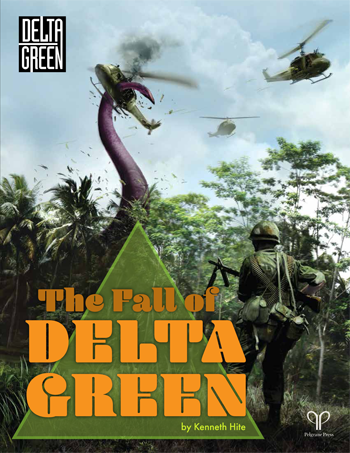
System: The Fall of Delta Green (GUMSHOE)
GM: Aser Tolentino
6 Players: Joshua C., Kai H., Charles P., Jack Y., Keith P., Morgan H. (all players showed, no crashers)
At the height of US involvement in the Vietnam War, an artifact goes missing from a secret holding facility. Elsewhere, a Navy patrol boat has been reported overdue. These events are connected, but finding out how may cause agents to regret their decision to go up country.
Aser is really seeped in Vietnam war lore. Gil T. is a better man than me. He went to Texas to get the vote out, so he yielded up his seat and I took it. I think Gil would have really geeked out in this game.
I enjoyed the game, but Josh and Jack had issues with the combat system. In retrospect, I agree with them. Trail of Cthulhu combat really is lacking. This really seems to mute the feel of danger, especially when modern weapons are very, very deadly.
I think the highlight of this game was the vivid details of the locations and the combat, I felt like we were In Country.
=== SPOILER SECTION START ===
We go to the secret holding facility and question a guard who got knocked out and we found what was missing and who did it. We then researched both and found that the culprit was a highly competent River Rat (graduate of Miskatonic University and from Kingsport) and the object was a stone artifact from a tunnel system.
Immediately, alarms go off in our head about Deep Ones.
We head Up River following our lead and kill a lot of NVA, in sampans, in rice paddies, on mountain trails, etc. We follow the transformed River Rats into the tunnel system and find horrible things, people die, and two PCs survive. Survivors call in an airstrike and destroy the tunnel system.
=== SPOILER SECTION END ===
Sun Oct 14, 9:00 AM - 1:00 PM The Box - An Object Discovery Game
System: The Box
GM: Rick Dean
6 Players: Julie F., Jennifer B., Vylar K., Amber, Morgan H. (two no shows, one crasher)
The Box is a GMless story game about trying to understand the true nature or purpose of an esoteric object you’ve just discovered. You and your friends will encounter a strange box, open it, explore its intricacies, and unlock the mysteries of its contents. You will use cards to describe individual traits of the discovery as well as events at the scene. You will track your feelings toward the discovery as well, and the culmination of these collective feelings will help generate the climax and conclusion of your story. If you enjoy exploration, intricacy, divination, surprise, or opening strange packages, this game is for you! Beginners and virtuosos welcome. We will play one of the pre-set scenarios based on the group’s preference. Each scenario has pre-set characters to play which can be customized on the fly if need be. Probably won’t last the full 4 hours but usually takes longer than 2 🙂
Game tags: Adventure, Collaborative, Exploration, Investigation, Mystery, Rotating authority Divination
I really enjoyed this game. This is a prototype of an unpublished game run by the designer. Rick picked a play set for us. The play set describes the setting and gives us various pre-gens to select from.
There are 4 phases of the game. We take turns describing various aspects of the box (based on cards drawn), then open it, then describe layers of packaging (based on cards drawn), then describe the final object (based on cards drawn). Once that's done, we get to agree on what the object really is and its purpose.
There's a scoring based on our impressions of the box, layers, and object. That gives us the object's theme which we use to determine its purpose, based on some of the earlier descriptions placed into various abstract categories (4 random categories drawn from a deck).
This game is more than just about the box and the object, its about the interactions between it and the PCs. So, a whole story is built around its discovery and investigation of its properties. The game is fresh and has lots of possibilities for replay.
=== SPOILER SECTION START ===
The setting picked was a group of kids discovering a Box uncovered behind one of the kid's houses. A boulder had rolled down a hill. At the bottom of the hill, the Box lays there.
The pre-gens are just cards with a character name and 3 or fewer short lines describing the character. I picked the kid with a limp, has access to illegal fireworks, and a collection of cool marbles.
Players drew 4 random categories from a deck: Aesthetics, Support, Transport, Growth.
From the Box deck, each player in turn drew a card and got to narrate that aspect of the Box. For instance Color, Shape, Weight, Latches/Locks, etc. You are allowed to only narrate about that aspect and nothing else. This is great because it shortens what a player can narrate about. No long monologues. 😊During each narration, players may spend tokens to take any aspect described to be placed either randomly (by die roll) or deliberately under any of the 4 categories.
Once the Box deck is finished, the Box is opened (a player narrates that). Players then write down secretly how they feel about the box (1 to 5, scared to in awe). The game then moves to the Layers (packaging) phase.
Our Box was a weird trapezoidal, ceramic, blue/purple swirly, hinged on each side (one hinge rusty), ancient with tree roots wrapped around it, with occasional hand prints randomly appearing on its surface. When opened, the lid levitated above the box and a blue light shined down from the lid.
Once the Box was opened, we see a Layer wrapped around the Object.
Players are handed 2 Event cards, examine them, and an unwanted one is returned to the Event deck.
Players can either play an Event card (in hand, or pick one from the Event deck) and narrate it, or pick to describe the Layer or Dive deeper to another Layer, or get to the Object. During play, tokens can be spent to put aspects under any of the 4 categories.
Our first Layer was a blue cellophane that melted on touch and tasted like mint.
The next Layer underneath was an Egg-like shell.
Due to a chain of events, one of the kid's mothers (from the house) showed up and told us to leave the Box, then cops showed up, and barricade the Box, then we distracted the cops with fireworks, and we stole the Egg and took it to an abandoned house in the neighborhood. Once the Egg was removed, the blue light and the hands on the Box turned off.
In the abandoned house, we continued to examine the Egg. It had blue lights running around it and faces sometimes showed up like the hands earlier. The Egg had indecipherable script on it that can only be viewed with a blue filter (via one of my blue marbles).
A player then decided to get to the Object and got to narrate how that happened. The Egg started to hatch with cracks showing and then when it did open up, the Egg shell crumbled into dust.
Players then wrote down how they felt (1 to 5). The game then moved to the Object phase.
Players are handed 2 Object cards and examine them. Object cards are similar to the Box cards except there some more variety. Once all the Object cards are used, the game moves to the final phase. During play, tokens can be spent to put aspects under any of the 4 categories.
The Object was a human face with hands and fingers as ears, it has a long tongue and has fingers on its tongue. It makes the room warm and exudes a pleasant smell. When it speaks, subtitles appear and then the translation in English. When we speak, subtitles appear and its translation appears in the alien script. When one of the PCs duplicated its gesture, it licked her. My PC then duplicated the gesture and spoke one of the words it spoke, then we were transported to a Dr Seuss-ish alien world. A blue butterfly landed on it and it dissolved into its face.
At that point we used up all the Object cards. Players then scored how they felt (1 to 5).
I must of forgotten a step somewhere because there were 4 scores, but anyway, the scores are tallied and using a magic wheel, a series of symbols are calculated and those are used to look up the theme/purpose.
Our theme was Entrust (plus a short description).
We then discussed what we thought that meant and looked at the 4 categories and the aspects under each and we finally agreed that the Object's Purpose was to make first contact, make anybody it contacts comfortable and reassure them, to learn about the new culture and language, and then once it was comfortable, it would take or show the people it trusted its own world to start a cultural exchange and in effect grow its sphere of influence through diplomatic means.
As you can see, this game can go any way (horror, sci-fi, fantasy, crime drama, etc.), have many skins and through the cards, naturally limit the open endedness of the game (limited monologuing), and the limited number of cards forces an ending.
I really enjoyed this game and see its myriad possibilities.
=== SPOILER SECTION END ===
Sun Oct 14, 2:00 PM - 8:00 PM
Assault on Singularity Base
System: Cypher System
7 GMs: Matthulhu Steele, Ezra Denny, Jack Young, Shannon McNamara, Morgan Hua, Andy Hull, and Sean Phelan
36 Players: 6 players per table. 6 tables. (several no shows, some crashers)
An amazing multi-group gaming experience! The Empress Tahali V, leader of the Grand Imperium, controls the galaxy with her countless legions of Imperium troopers clad in glistening silver armor marked with her griffon symbol. But a ragtag band of Rebels fights against the Imperium, their determination, bravery, and skill making up for their lack of numbers and supplies. The Rebels have recently discovered that the Grand Imperium is creating a super weapon that can destroy an entire star system. Rebel spies have tracked a prototype of this superweapon to an Imperium base—called Singularity Base— on a remote swamp world. Your group is one of six Rebel teams attacking in a coordinated but desperate assault. Each team has its own objective, contributing toward the common goal of eliminating the superweapon prototype. Assault on Singularity Base is a unique adventure that pits not one, but six groups of PCs against the Imperium forces, run as a mega-event with 36 players and seven GMs. This adventure debuted as the official GenCon 2016 Cypher System event. It plays similar to the last act of Rogue 1, using the Cypher System’s Rebel Galaxy setting.
Game tags: Adventure, Combat, Hijinx, Light, Play to find out, Sci-Fi, Serious Sci-Fi Action
Our third run of this game. Ezra had 2 players and I had 4, so we combined tables and gave our group two missions. Both our missions were pretty short, so it was a natural fit.
I really enjoyed running the game with Ezra and being able to sit out some of the game was a blessing since it was the last game of the convention and I was really tired. Ezra said the same thing.
We were also able to play off of each other which was fun and then NPCs can talk to each other without the GM sounding like a crazy street person talking to himself.
Team completed both missions and everyone survived.
=== SPOILER SECTION START ===
This is the first group to actually tactically prepare when the elevator arrived. Only one PC stood at the door when it opened.
First group to just execute people in cold blood. Two troopers pinned under a door surrendered, but one of the PCs just walked up to them and executed them. It's pretty chilly in here. (I liked how that player kept on explaining that it was the right thing to do, even out of game.)
This group was a lot smarter in what they did. More tactical. I think other groups just came in shooting.
I just went to GenCon 2018 and ran 4 games of Delta Green, played in a Delta Green LARP, and played in a private Delta Green game run by Shane Ivey. Delta Green also won 6 ENnie Awards (3 gold, 3 silver) at GenCon.
What's the difference between Delta Green (DG) and Call of Cthulhu 7th Edition (CoC)?
Setting and Atmosphere
DG: Modern
If Scully and Mulder worked for the Smoking Man.
CoC: Default 1920s
Being stuck in a H.P. Lovecraft story.
Commentary: Modern is very accessible, whereas 1920s is harder for new players to get into since it's before their time. Though, CoC has rules for Dark Ages, Roman Invictus, Westerns, Victorian Gaslight, and Pulp 1930s.
I do want to mention that if you want to play in the Modern era, DG would be easier for the Players as DNA, fingerprints, CCTV, facial recognition, cellphone GPS records, your neighbors RING system, license plate readers, credit card history, bank history, browser history, social media footprint, emails, text chats, firearm licensing, ballistics, ShotSpotters, modern forensics, etc make covert acts really hard to hide from the authorities if you're an ordinary citizen. Connections to a covert govt organization makes life a lot easier.
Characters
DG: Generally law enforcement officials or someone working for the government.
CoC: Normal everyday people from all walks of life.
Commentary: DG assumes you are competent and are trained and are willing to face down horrors. CoC assumes that you are just a normal Joe who runs into something horrible and will run away screaming. Though eventually, you'll learn to become an Investigator who fights the good fight.
DG is still using the old raw Characteristics (CoC 6th Ed) / Statistics (DG) scores and generally requires a STAT x 5 for die rolls.
Bonds and Backstories
DG: Characters have bonds that represent their home life, like their spouse, ex-spouse, children, parents, friends, co-workers. You can reduce SAN loss by Projection, where you damage your bonds as you take out your frustrations from work into your home life.
CoC: Characters have attachments to significant people, places, or things. They can spend quality time with significata to regain SAN.
Commentary: I love Projection in DG and how it models the stereotypical cop whose family life has gone down the drain because he spends too much time at work and can't talk about the serial killer or the gruesome crime scene with his loved ones. Two different approaches here and DG definitely has gone with grimdark.
Insanity
DG: Has split up threats to SAN into Violence, Helplessness, and Unnatural. And you can harden yourself to Violence and Helplessness. A 5 point SAN loss causes Temporary Insanity which results in a Fight, Flight, or Freeze decision. There's also a Breaking Point. If your SAN hits the Breaking Point, you get a psychological disorder.
CoC: A 5 point SAN loss has a chance of Temporary Insanity, the result can be from a random chart. If you lose 20% of your SAN during a game day, you get an Indefinite Insanity.
Commentary: I like DGs 3 threats to SAN. DG's Breaking Point and CoC's Indefinite Insanity are pretty similar. DG's Temporary Insanity does let you game the system a little. Whereas CoC's Temporary Insanity goes to a random chart. I have a variant for convention play, if multiple PCs go Temporary Insane, I make each throw a Fight / Flight / Freeze card into a hat, then mix it up, and then deal them out randomly, but one table outsmarted me and all agreed to Fight before putting their cards in. 😎
Unnatural and Cthulhu Mythos
DG: Unnatural Skill is knowledge about anything not natural such as the Cthulhu Mythos.
CoC: Cthulhu Mythos Skill is knowledge about "that which man is not meant to know."
Commentary: They're the same thing.
Levels of Success
DG: Critical Success > Success > Failure > Fumble.
In Delta Green, if you roll doubles with your percentile dice (11%, 22%, 33%, ... 88%, 99%, 100%), it's either a Critical Success or Fumble. A Critical Success if it's equal or below your skill %, a Fumble if it's above your skill %. A special exception is 01% which is always a Critical Success. If it's a contested roll, compare levels of success. If there's a tie in level, whoever rolls highest with a success wins. e.g. a Success roll of 48 > Success roll of 12.
Also Delta Green uses a mechanic similar to Trail of Cthulhu. Depending on how the scenario is written (in one scenario a 30% in Computer Use was all that was needed for an automatic success), if your skill % is considered sufficient, no die roll is needed, it is considered an automatic success.
CoC: Critical Success > Extreme Success > Hard Success > Regular Success > Failure > Critical Failure.
Roll 01 = Critical Success. Roll below or equal to 1/5 skill % = Extreme Success. Roll below or equal to 1/2 skill % = Hard Success. Roll below or equal to skill % = Regular Success. Roll over skill % = failure. Roll 100 = Critical Failure or if skill is equal or greater than 50%. Roll 96-100 = Critical Failure if skill is < 50%.
If it's a contested roll, just compare levels of success. If there's a tie in level, then compare the skill %, higher skill % wins. e.g. two guys are racing cars. First guy has driving at 60% and the 2nd guy has it at 20%. First guy rolls 28 = Hard Success. 2nd guy rolls 8 = Hard Success. 60% > 20%, so 1st guy barely beats out the 2nd guy.
Commentary: The beta test of CoC used to use the same method as DG, comparing the highest successful roll, but when I play tested it, people kept on picking up their dice. They just remembered that they succeeded and the level of success, but not what they rolled. Between the two, I'd say they're about the same, but given the propensity of people to pick up their dice after rolling, I'd give CoC the edge. But if you're running online with a robotic dice roller, you can examine the die rolls afterwards.
Advantages / Disadvantages
DG: Stayed with the old style of +/- 20%, +/-40% for each advantage/disadvantage. If you have an advantage of some sort, you'd get +20% to your skill roll.
CoC: Added a bonus die or penalty die for each advantage or disadvantage up to a max of 2 bonus or penalty die. If you have an advantage of some sort, you'd get to roll an extra 10's die and take the best die roll. e.g. Roll two 10's die and get a 50 and a 20. The 1's die is an 8. So, the choice is 58 or 28. Taking the best roll, 28.
Commentary: People get confused about the CoC bonus die until you show them how it works, then it's ok. The math for the bonus and penalty die are a bit complicated and hard to get a gut feeling for. And it is used frequently when shooting multiple bullets. Basically, if you have a very high firearm skill % (60% or higher), it's worth taking multiple shots and having a penalty die, otherwise you should just do single shots. I like rolling extra dice, it's fun, but for simplicity's sake, DG makes it easy to understand. So, the edge goes to DG.
Hand-to-Hand Combat - Defending
DG: You can either Dodge, Fight Back, or Do Nothing. If you haven't acted, you may Dodge or Fight Back an attack, and all subsequent attacks, against you that round; this will count as your action. Dodge works against all hand-to-hand and range attacks (if there is cover, dodging for cover). Fight Back only works against hand-to-hand, not range attacks. Compare levels of success, highest level of success wins. Dodge success means defender is missed. Fight Back success means your offensive action succeeds against the specified attacker instead of you being hit, other attacks are only blocked. The only reason to Dodge is if you're being shot at, otherwise I see no reason to Dodge (unless you have a much higher Dodge than Combat skill). If you already acted or want to do something else on your action such as run away, you'll have to Do Nothing and hope the attacker misses. If you act first (highest DEX) and attacked with hand-to-hand, your die roll, if successful, is kept as a high water mark that other attackers must beat, in effect acting as if you picked Fight Back.
CoC: You can decide to Dodge or Fight Back against every hand-to-hand attack against you. You can decide on an attack by attack basis. The difference is on level of success. Dodge: If you meet or beat the level of success of your attacker you Dodge the attack. Fight Back: If you beat the level of success of your attacker, you do regular damage to your attacker instead of being hit. You can Dive for Cover against guns (p.113 Keeper Rulebook), but that actually takes your action or future action (if you've already acted that round), and it only gives your attacker a penalty die, if you succeed.
Commentary: I prefer CoC. It's easier to keep track of. And you can mix and match Dodge and Fight Back during combat.
Automatic Weapons and Explosives
DG: Added a Lethality % to various weapons. Instead of regular weapon damage, you roll % dice for each target. If you roll the Lethality %, it's an instant kill. If you don't, just add the two digits together. e.g. Roll 58 (missed the 10% Lethality), so damage is 5 + 8 = 13 pts damage. So basically, every mass damage weapon defaults to 2d10 damage, and sometimes it'll just kill you outright. Most people have about 11 hit points, and the average damage of 2d10 is 11, so on average it'll kill you anyway.
CoC: Added a crazy math problem where you figure out how many bullets are in a volley, each additional volley gets a penalty die to hit, and how well you succeed determines how many bullets hit.
DG: Luck is just 50%. But Critical Successes and Fumbles can happen.
No such thing as Pushing, but if a skill % is high enough, you can get an automatic success, based on how a scenario is written or GM largesse.
CoC: Luck is a stat (3d6 x 5%) and optional rules let you spend luck to improve die rolls.
PCs can try a different tactic (original Intimidate failed, now try Fast Talk) or retry a skill by Pushing. This allows a reroll, but on failure, the result would be a Critical Failure which is discussed beforehand, before the roll. Once the stakes are decided on, the PC can decide to Push or not.
Commentary: I like spending Luck and having people with different levels of Luck. So, I prefer CoC's Luck rules vs DG's straight coin toss. Pushing is also a great rule change that ups the ante.
Skill Advancement
DG: Check the checkbox next to your skill when you fail. At the end of the scenario, gain 1d4 in that skill. It was originally 1%, but it was changed to 1d4. Errata (Agent's Handbook, Improving Skills).
CoC: Check the checkbox next to your skill when you succeed (if you didn't use a Bonus Die or Luck spend). At the end of the scenario, roll % dice. If you fail, gain 1d10 skill points in that skill.
Commentary: Assume you have a skill at 50% and used it only once per scenario. In CoC, after 10 scenarios, on average you'd gain +13.75% in that skill (10 * 50% * 50% * 5.5 = 13.75). In DG, you'd gain +12.5% (10 * 50% * 2.5 = 12.5). And surviving 10 scenarios in a DG or CoC game is a feat in itself.
That makes them pretty similar, then the question is whether you want PCs to try skills they're good or bad at. CoC awards you for succeeding, so if you're going to metagame the system, try skills you're good at. DG awards you for failing, so if you're going to metagame the system, try skills you're bad at.
But in practice, PCs will try their best skill and only try a weaker skill when push comes to shove. DG does award a PC with a booby prize of 1d4 skill points when they fail a skill roll. In CoC, when a PC gets a miracle success, for a skill they have a base chance in, they generally will increase that skill.
The Books
DG: Agent's Handbook is needed for Character Creation and the Game Rules.
Handler's Guide does not have the Game Rules, but has the History and World of Delta Green, including the Unnatural.
CoC: Investigator Handbook is needed for Character Creation, Investigator Organizations that a PC might be part of, and History of 1920s, but no Game Rules.
Keeper Rulebook has Game Rules and Character Creation, Monsters, Eldritch Tomes and Spells, and Alien Artifacts.
Commentary: To play DG, you only need the Agent's Handbook. To play CoC, you only need the Keeper Rulebook.
Summary
Commentary: For me it's a toss up. I'll play either.
I've been looking for a Smiley's People game and World War Cthulhu: Cold War (WWC: CW) delivers. All the books use CoC 7th Edition rules. The setting is 1970s. I ran all 6 scenarios from Covert Actions and really enjoyed the games. I did realize there was a formula to the scenarios though. There's a MI6 mission and a Section 46 mission (Section 46 is a covert anti-Mythos organization), so there's really 2 missions in every scenario which makes for a good complicated scenario. The two missions do not necessarily have to have anything to do with each other and succeeding in one may necessitate failing in the other. So, really cool choices for the PCs.
There are a few minor typos in Covert Actions and not all missions spell out the mission rewards completely. e.g. There should be SAN rewards for completing the mission, Trust rewards/penalties for the MI6 mission, Trust rewards/penalties for the Section 46 mission. Not all scenarios provided a good breakdown of the rewards, so I had to make some up on the spot. Basically it should be +/-1d6 Trust for MI6 success/failure and the same for Section 46 success/failure.
The scenarios have loads of real life locations, but not enough illustrations, so I did massive Googling of pictures for every scenario. And that added a lot of flavor to every game. In some scenarios, 10 locations are mentioned without much description (and in only a few pages), but once I Googled the locations, things came to life.
My favorite scenarios were: The Forcing Move and Puddles Becomes Lakes.
Least favorite: Operation Header.
In preparation for running, I read a lot of real life spy books: "Mossad: The Greatest Missions of the Israeli Secret Service," "Gideon's Spies: The Secret History of the Mossad," "The Billion Dollar Spy: A True Story of Cold War Espionage," "The New Spymasters: Inside Espionage from the Cold War to Global Terror," "A Spy Among Friends: Kim Philby and the Great Betrayal," "A Very Expensive Poison: The Definitive Story of the Murder of Litvinenko and Russia's War with the West," and "Operation Shakespeare: The True Story of an Elite International Sting." There must be some unspoken rule about using colons in a non-fiction spy book title. 😎
Upon reading these books, I found that WWC: CW lacked some details and I used the details I found in the books to good use. For instance, every diplomat in Russia gets followed and it takes about 4 hours of Tradecraft before you can figure out if you've lost your tail or not (90% certainty). So, it's not a simple, I go out and then try to lose my tail. It's a I gotta meet my asset, so I'll leave 4 hours before our meeting time. If I think I'm being followed, I don't meet my asset. This also explains meeting in parks and graveyards where you can easily spot a tail or watchers.
For those interested, I built a website for the games with recording of the Sessions, lists of PCs, NPCs, and Handouts. Website Link Here.